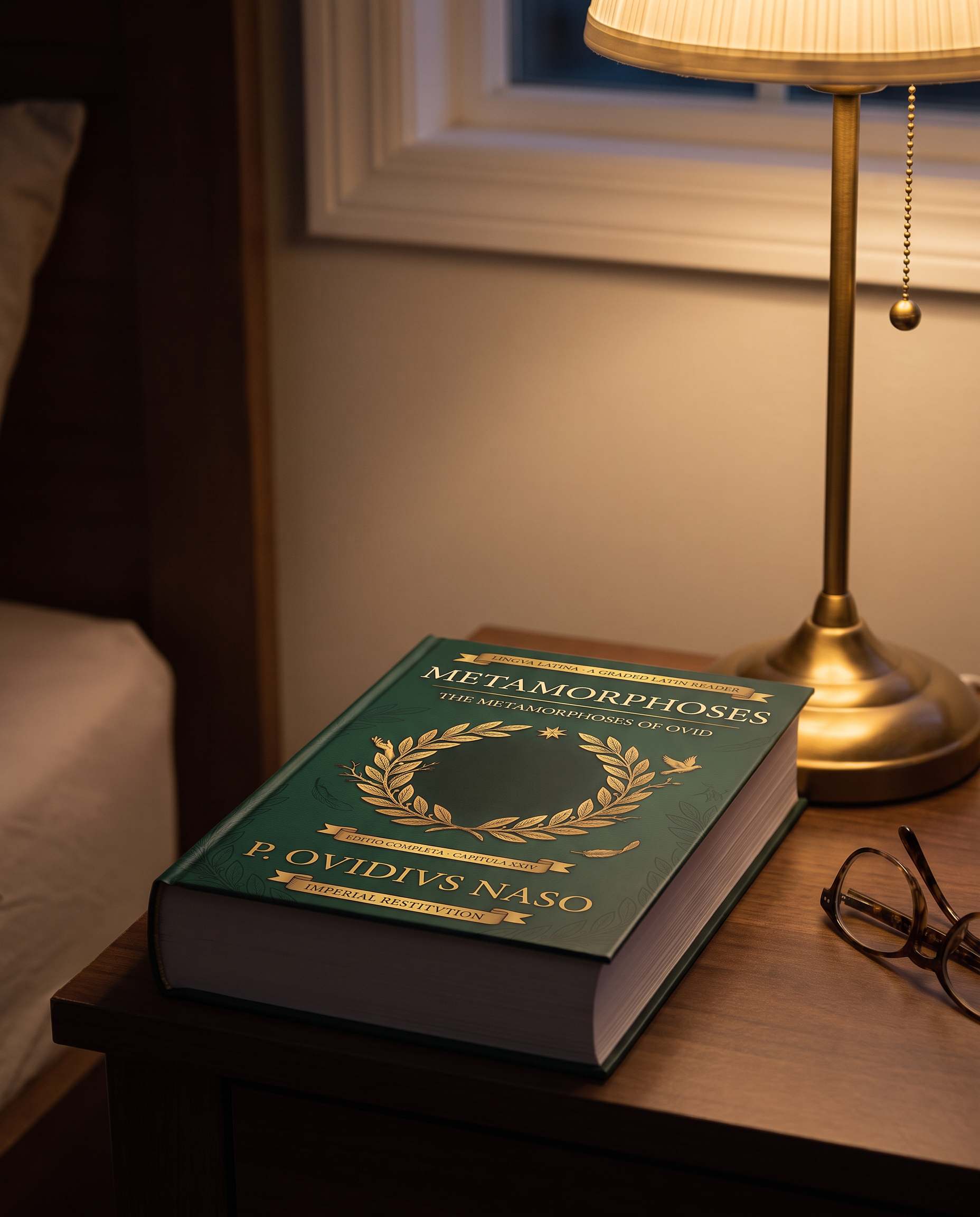
Read Ovid. In Latin. No dictionary required — and this time, all of it.
Around the year 8 AD, Publius Ovidius Naso finished the most ambitious storybook antiquity ever produced: fifteen books of hexameter verse tracing the history of the world through its transformations, from the first shaping of chaos to the deification of Julius Caesar. He called it a carmen perpetuum — one continuous song, story flowing into story without a seam. Two thousand years later, the Metamorphoses is still the single greatest source of classical mythology in Western art and literature: Daphne becoming the laurel, Narcissus at the pool, Icarus falling from the sky, Pygmalion's ivory girl waking under his hands.
This Editio Completa retells that entire arc as one continuous story in clear, graded Latin — twenty-four chapters in a single volume of more than 760 pages, following the poem's own order from In Nova Corpora (chaos, creation, and the four ages) all the way to Iamque Opus Exēgī, the poet's final claim on eternity. It is the complete journey of our two-volume Metamorphoses set, bound as one book at one price.
"In nova fert animus mūtātās dīcere fōrmās corpora."
— Ovid, Metamorphoses I.1–2, the poem's opening promise
Twenty-Four Myths, One Continuous Song
Every chapter is one complete myth, told whole — never a snippet, never an excerpt torn from context. You begin with the creation of the world and the great flood that leaves only Deucalion and Pyrrha to throw stones over their shoulders. Apollo chases Daphne until her arms become branches. Phaethon borrows his father's sun-chariot and scorches the earth. Actaeon stumbles upon Diana bathing and is torn apart by his own hounds while still thinking human thoughts inside the stag. Arachne beats a goddess at the loom and pays for it; Niobe boasts of fourteen children and loses all of them; Daedalus builds wings of feather and wax and watches his son fall into the sea that will bear his name. Orpheus sings the underworld to a standstill, wins Eurydice back, and loses her with a single glance. Midas wishes for gold and learns to regret it. And in the final chapter, Pythagoras teaches that omnia mūtantur, nihil interit — everything changes, nothing perishes — before Caesar's soul rises as a comet and Ovid pronounces his own immortality.
Ovid's transitions are preserved as bridge sentences between chapters, so the book reads exactly as the poet designed it: fābula post fābulam, story after story, without a break. The volume closes with an epilogue on Ovid's exile to the Black Sea — the mysterious carmen et error that ended his life in Rome — and the epitaph from his exile poetry, whose prophecy of being read forever this book itself quietly fulfills.
How the Graded Method Works
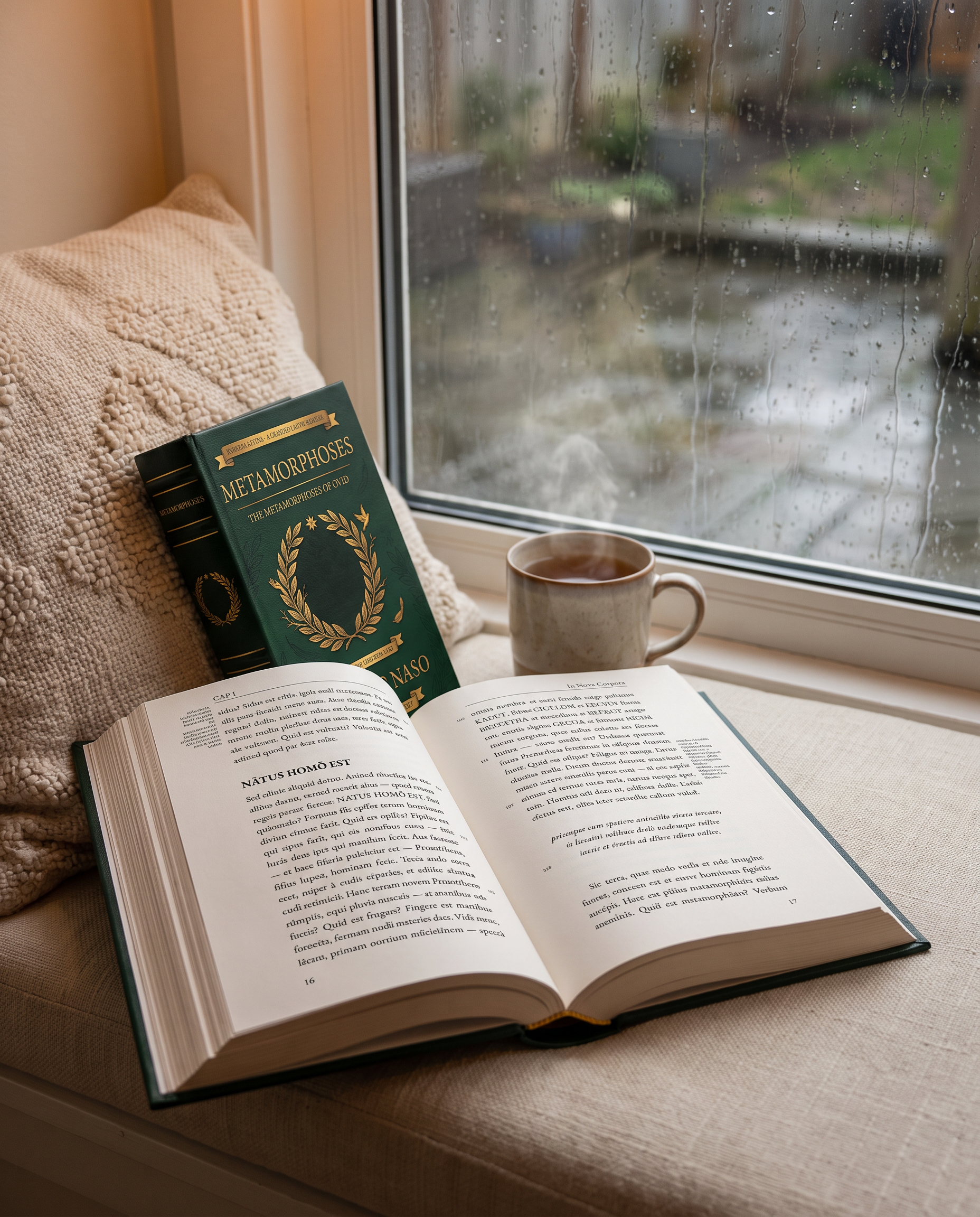
This is a reader in the tradition of Hans Ørberg's Lingua Latina per sē Illūstrāta: real Latin, explained in Latin. Every new word is glossed in the margin, in Latin, the moment you first meet it — a picture, a synonym, a short Quid est? definition — so you never leave the language to consult a dictionary. Macrons mark vowel length on every word of every page, training your ear for the rhythm of the poetry from the first sentence. The grading never breaks across the whole volume: chapter one is written in simple, transparent prose; by the final chapters you are reading near-classical Latin without noticing when the climb happened.
Then there is the feature that makes this series different: the TEXTUS ORĪGINĀLIS. Every chapter quotes Ovid's actual hexameters — fully macronized — at the precise moment the story reaches them. When Narcissus finally understands, you read his own iste ego sum in Ovid's verse. The passages grow with you, and the book ends with the complete, uncut finale of the epic, Metamorphoses XV.871–879, read in the original. A gentle verse primer, Dē Arte Metricā, opens the volume and teaches you to hear the dactylic hexameter before you ever meet it, with Ovid's own proem scanned line by line.
The Metamorphoses turns out to be the ideal poem for this method for a reason Ovid never intended: he describes every transformation limb by limb. Fingers lengthen into branches, hair hardens into leaves, arms feather into wings. Each metamorphosis is a guided tour of the vocabulary of the body and the natural world, taught by the most vivid images in Latin literature.
Who This Edition Is For
The Editio Completa is built for readers who want the whole journey in one binding. If you have finished Familia Romana or an equivalent first-year course, you can start on page one. Homeschool families can build an entire year of connected Latin reading around a single text — one book, one story, one steady climb. Students preparing set myths such as Pyramus and Thisbe, Icarus, or Echo and Narcissus will find each of them told completely, with the famous lines in the original. And because the Metamorphoses is the skeleton key to Western art — Bernini, Titian, Shakespeare, Rilke all drew from it — it rewards anyone who simply wants antiquity's greatest storybook on the shelf, read in Latin, cover to cover.
A complete learner's apparatus closes the volume: a full Index Verbōrum with over 1,300 entries defined in Latin (presumed background vocabulary marked with a dagger and explained), and Persōnae Fābulārum, a review of the whole cast from Jupiter to Ovid himself. Twenty-four full-page photographic plates, engraved margin illustrations of ancient realia, a myth-map of the Mediterranean (Orbis Fābulārum), and a family tree of the gods (Arbor Deōrum) round out the book.
Where It Sits in the Series
This is the fifth reader in our Lingua Latina series, and its summit. The path runs from the Strategemata readers through Caesar's De Bello Gallico and Pliny's Epistulae to Vergil's Aeneis — and ends here, with the poet who turned all of mythology into one continuous song. The same text is also available as two matched volumes, In Nova Corpora and Carmen Perpetuum, each offered in a premium color hardcover; the Editio Completa is the single-volume paperback for readers who want it all between two covers. Browse the whole collection on our Latin Books page.