01011001 01101111...
This is how the message arrives. Not with a greeting, but with a death sentence, decoded by SETI from a tightbeam transmission in 2025. It is the first hint that humanity is not alone. It is the last warning they will ever receive.
It began with 'Oumuamua. The anomalous interstellar object that tumbled through our solar system in 2017, a splinter in the mind of science. Was it a natural phenomenon, or something else? The world's astronomers debated, while a few lone voices in the intelligence community and academia warned it was a scout. They were dismissed as alarmists.
They were right.
Two years later, a second visitor, Borisov, arrived—a natural-looking comet that restored complacency. Now, a third visitor has been detected. It is not hiding. It is not subtle. It is the size of a small moon, decelerating into our system on a trajectory that defies physics. It is not here to observe. It is here to sterilize.
The universe is not silent; it is a Dark Forest.
— Liu Cixin, The Three-Body Problem
With the clock ticking down to extinction, a desperate, clandestine alliance is formed, operating in the shadows of global panic:
- • A disgraced Harvard astrophysicist whose "heretical thoughts" were the only accurate threat assessment.
- • A haunted Space Force commander who must now orchestrate humanity's escape.
- • A reclusive Chinese billionaire who has built a private space program for this very nightmare.
- • A quantum computing prodigy whose AI may be humanity's most dangerous weapon—or its successor.
- • A tormented historian who knows that this has all happened before.
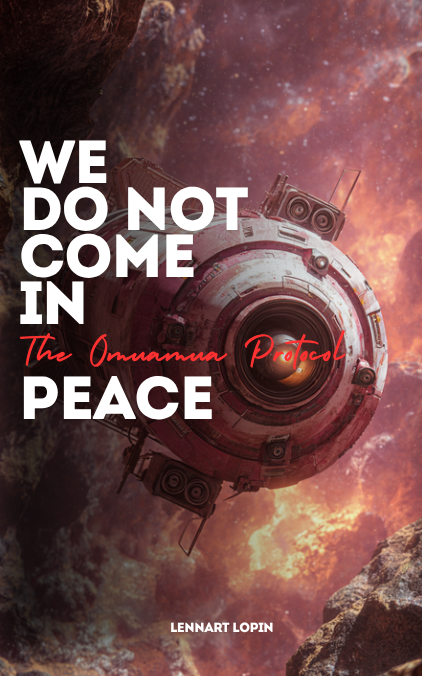
We Do Not Come In Peace is a sweeping saga of hard science fiction and cosmic horror, weaving together real-world science, military strategy, and philosophical inquiry. In the tradition of Cixin Liu's The Three-Body Problem and the epic scale of Arthur C. Clarke, it is a story about humanity's last, defiant stand against a universe far grander and more terrifying than we ever dared to imagine.