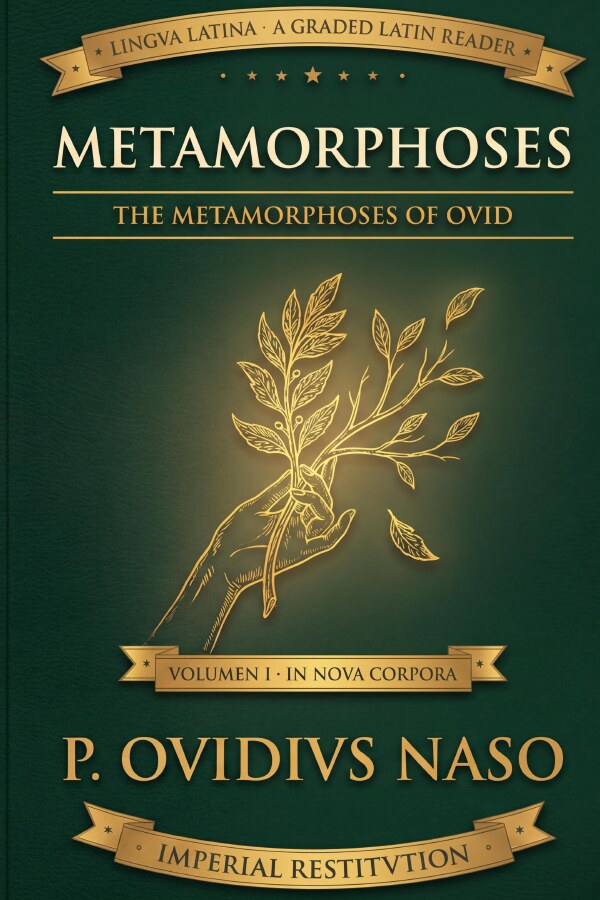
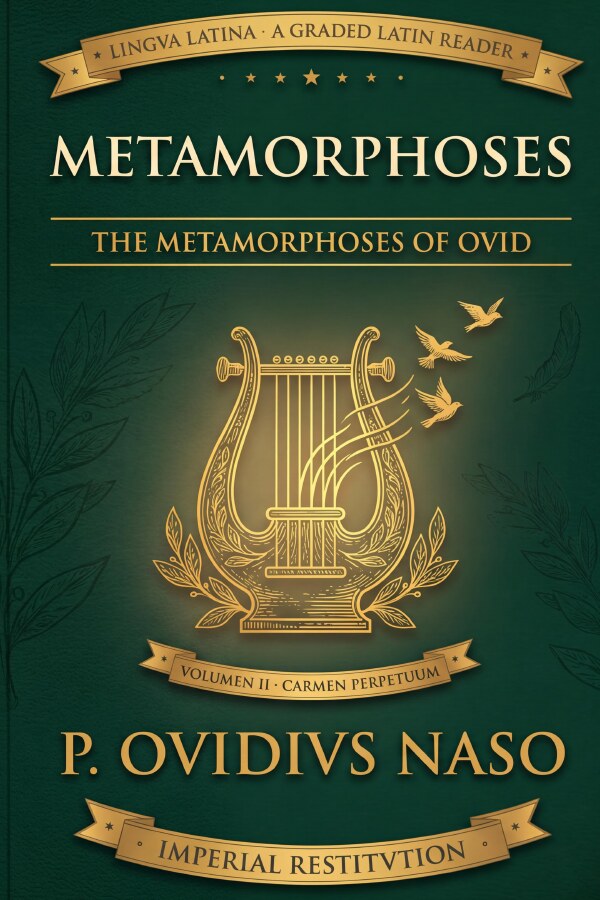
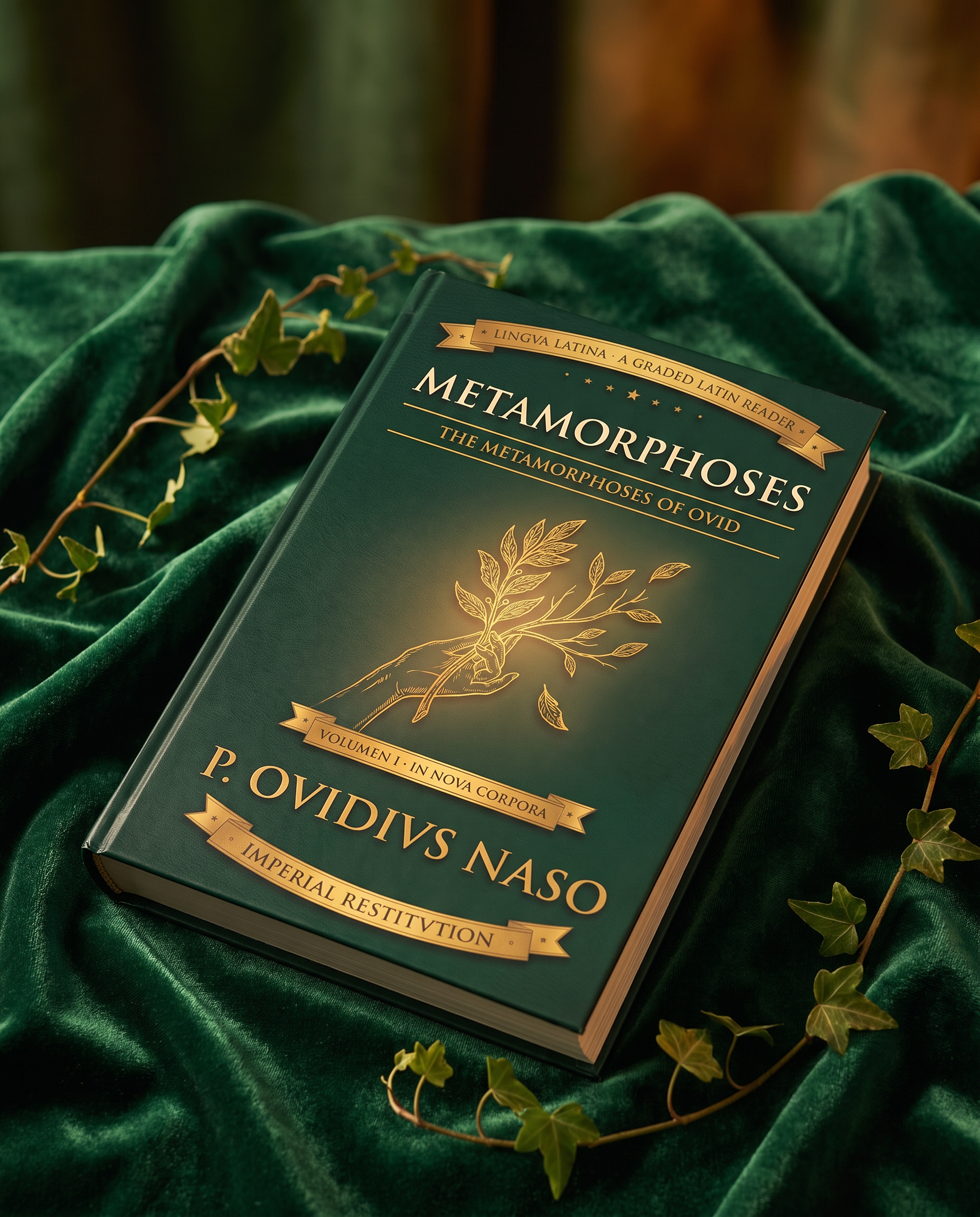
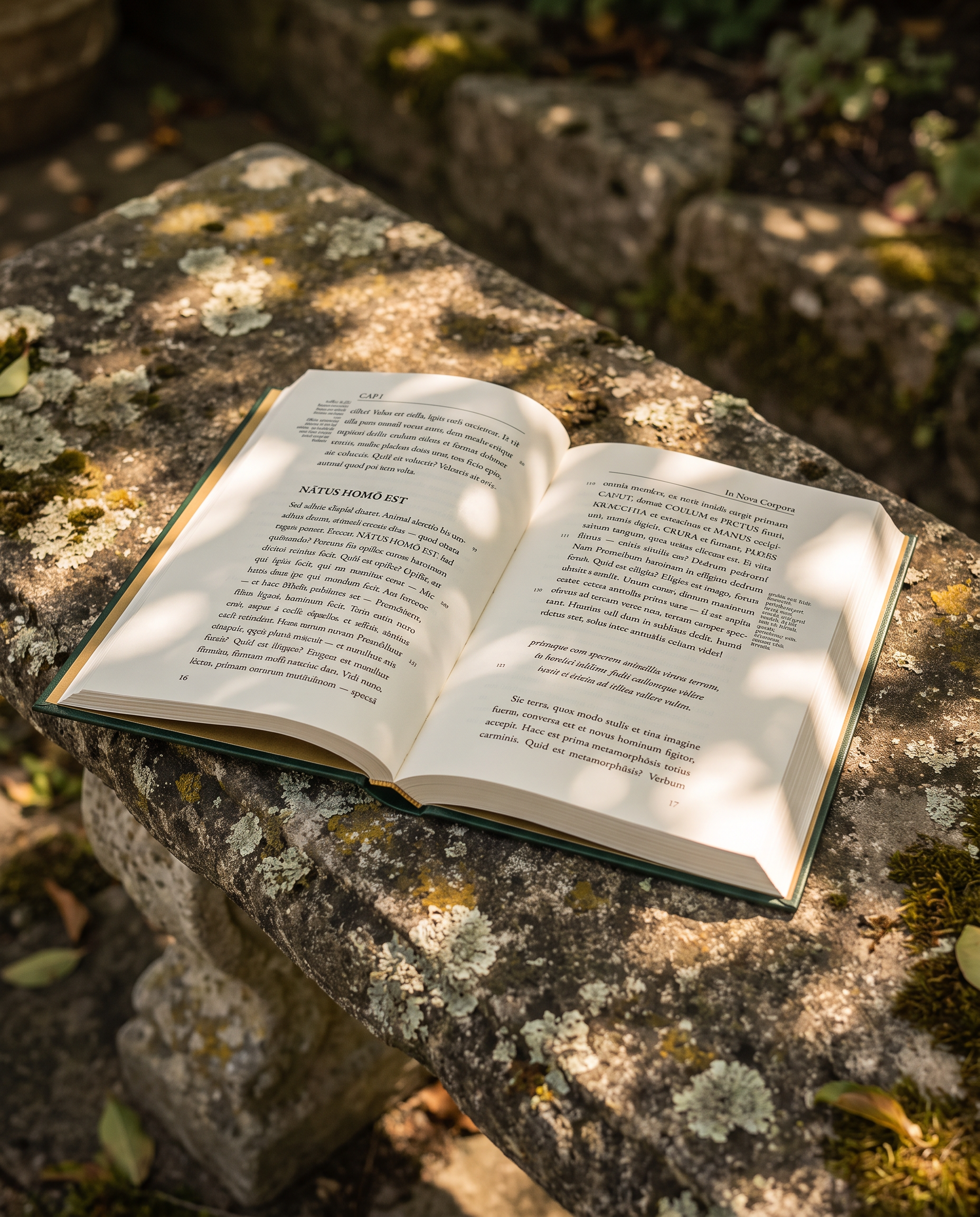
In nova fert animus mūtātās dīcere fōrmās corpora — "My spirit moves me to tell of shapes changed into new bodies." With those words Ovid opened the most beloved storybook of the ancient world. This volume lets you read it in the language he wrote it in.
The Metamorphoses is Rome's great treasury of myth: fifteen books of continuous verse, a carmen perpetuum that runs from the creation of the cosmos to Ovid's own day, stitched together by a single idea — everything changes. Girls become trees, boys become flowers, a weaver becomes a spider, tears become springs. For two thousand years it has been the West's mythology handbook, the source behind Shakespeare, Bernini, and every retelling of Daphne or Narcissus you have ever met. Yet most learners only ever encounter it in translation, or as a few disconnected lines in an exam anthology. Volume I: In Nova Corpora restores the whole first arc of the poem — twelve complete myths, Creation through Arachne — retold in clear, graded Latin that a motivated learner can actually read, cover to cover.
What Happens in Volume I
The book follows the poem's own order, so the myths carry each other forward exactly as Ovid designed. You begin with Chaos and the shaping of the world, the Four Ages of humankind, and Lycaon — the king whose cruelty turns him into a wolf and brings down the Flood, until Deucalion and Pyrrha remake the human race by throwing stones over their shoulders. Then the love stories and the punishments: Apollo chases Daphne until her arms become branches and her hair becomes leaves; Io is turned into a white heifer and guarded by hundred-eyed Argus, whose eyes end up on the peacock's tail; young Phaethon demands to drive the chariot of the Sun for one day and falls burning from the sky; Europa is carried across the sea on the back of a too-gentle white bull.
The second half moves to Thebes and the great lovers. Actaeon stumbles on the goddess Diana bathing and is turned into a stag — torn apart by his own hounds while his friends call his name. Echo fades to a voice; Narcissus meets the boy in the pool and speaks one of the most famous lines in Latin poetry: iste ego sum — "that boy is me." Pyramus and Thisbe whisper through the crack in the wall and die under the mulberry tree, in the story Shakespeare turned into Romeo and Juliet. Perseus swoops down on winged sandals to save Andromeda from the sea monster; Proserpina eats the pomegranate seeds that split the year into seasons; and the volume closes at Arachne's loom, where a mortal weaver dares to out-weave Minerva and pays for her masterpiece by becoming the first spider.
How the Graded Method Works
This is a true Lingua Latina reader in the tradition of Hans Ørberg's Familia Romana: everything in it, including the learning apparatus, is in Latin. Every new word is explained in the margin, in Latin, the moment you first meet it — by synonym, picture, or a short Quid est? definition. There is no English glossary and no facing translation, because you will not need one. The stories start simple and grow with you; the myths themselves supply the motivation that grammar drills never can.
Two features make this edition converge on the real Ovid rather than orbit around him. First, every chapter culminates in a TEXTUS ORĪGINĀLIS — a passage of Ovid's actual hexameters, fully macronized, placed at the exact moment of the story it tells. When Daphne's transformation arrives, you read Ovid's own lines about the bark closing over her breast; when Phaethon falls, you read the epitaph the nymphs carve on his tomb. By the end of the volume you have read hundreds of lines of genuine Augustan verse, each one arriving when the prose retelling has already taught you its vocabulary. Second, a gentle verse primer, Dē Arte Metricā, opens the book and teaches you to hear the dactylic hexameter — with Ovid's own proem scanned line by line — before you ever meet it in the wild.
Ovid also happens to be a gift to vocabulary learners, and this edition leans into it. His signature move is to describe each transformation limb by limb — fingers to twigs, hair to leaves, arms to forelegs — which makes every metamorphosis a natural lesson in the words for the body and the natural world. Long vowels are marked with macrons on every word throughout, so you absorb correct vowel quantities from the first page. Engraved illustrations in the margins picture the realia of the ancient world — Cupid's two arrows, Perseus' winged sandals, Proserpina's pomegranate, Arachne's loom and shuttle — wherever a picture teaches faster than words. The back matter completes the apparatus: an index of nearly 700 words, and PERSONAE FĀBULĀRUM, a review of the whole cast in Latin, once you know their fates.
Who This Book Is For
Volume I is written for readers past the beginner stage — roughly Familia Romana level or its equivalent. Self-learners get the thing that is hardest to find: hundreds of pages of connected, compelling reading at their level. Homeschool families get a mythology course and a Latin course in one illustrated volume. Exam students meet Pyramus and Thisbe — a GCSE set text — inside its full context for once, and build the sight-reading fluency that anthology snippets cannot. And because these are the myths everyone half-knows already, the book also works as the gift you give the Latinist in your life: a full-color hardcover of the old stories, in the language they were made in.
Where It Fits in the Series
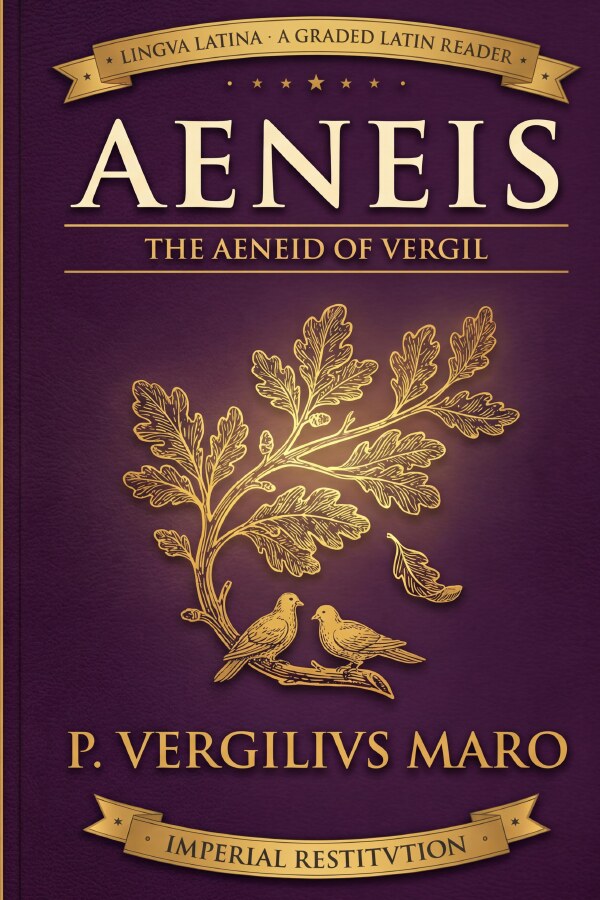
The Lingua Latina series from Imperial Restitution Press forms a reading path: the Strategemata volumes build your foundation through Roman military tales, Caesar's Dē Bellō Gallicō carries you through real historical prose, Pliny's Epistulae shows you daily Roman life in letters, and Vergil's Aenēis introduces epic verse. The Metamorphoses is the mythology volume — and the series' most purely delightful reading. Volume I ends at Arachne's tapestry; Volume II: Carmen Perpetuum picks up with Niobe, who knew Arachne — Ovid's own transition — and runs through Icarus, Orpheus, Midas, and the poet's closing claim to immortality. The old stories are not summaries here. They breathe, they joke, they grieve — and they change you a little, the way they changed everything they touched. In nova fert animus… Begin.