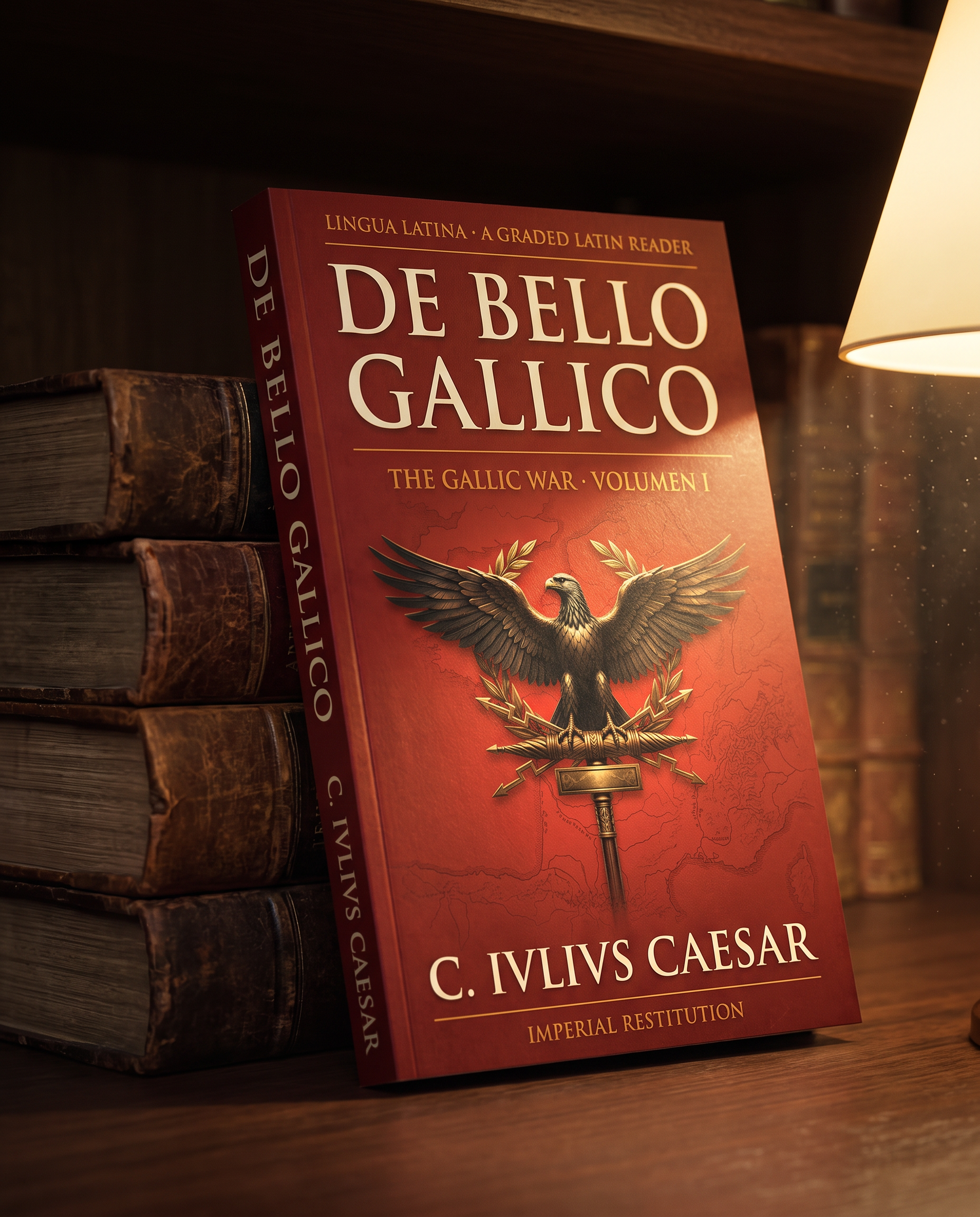
Gallia est omnis dīvīsa in partēs trēs. Every Latin learner dreams of reading those words the way a Roman did — and this book gets you there.
In 58 BC, Julius Caesar marched into Gaul and began a war that would last eight years, redraw the map of Europe, and produce the most famous prose narrative in the Latin language: the Commentāriī dē Bellō Gallicō. Caesar wrote his war reports in a Latin so clear and forceful that they have opened the door to classical literature for students ever since. But "clear for a Roman" is not the same as "easy for a beginner" — and that gap is exactly what this book closes.
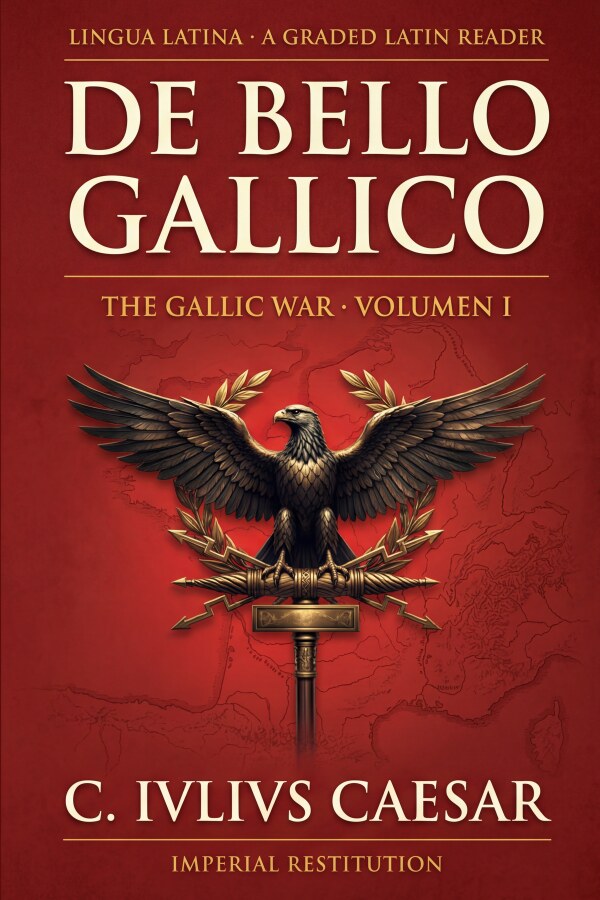
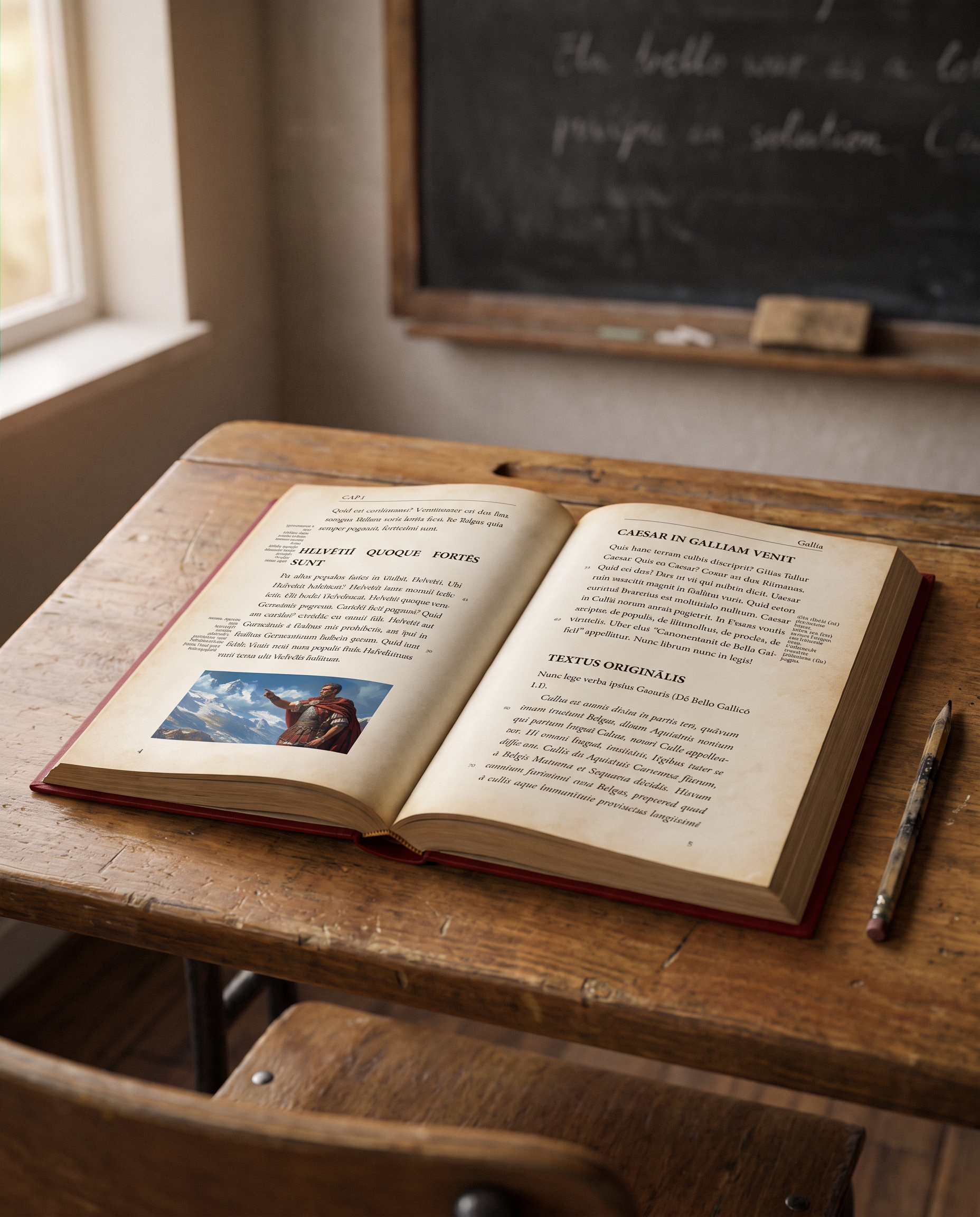
De Bello Gallico — Volume 1 presents Book One of the Gallic War complete — every episode, not a book of excerpts — retold as a living story in graded Latin that explains itself as you read. There is no English anywhere in the reading experience: no facing translation, no glossary that quietly does the work for you. Instead, every new word is explained in Latin, right in the margin where you need it — more than 600 glosses across the book — and every vowel carries its macron, so you absorb correct quantities from the first page.
The Story Inside
Book One of the Gallic War is a genuine thriller, and this volume tells all of it across twenty chapters. It opens with the doomed conspiracy of Orgetorix, the Helvetian nobleman who plots a migration — and a kingdom — and dies under mysterious circumstances before his trial (Mors Orgetorīgis). His nation goes anyway: the Helvetii burn their own towns and villages behind them so that no one can turn back (Oppida Ārdent), and a whole people takes to the road.
What follows is the campaign as Caesar lived it: the rampart he throws up to seal the Rhône crossing (Mūrus Caesaris), the crushing of the Tigurini at the river (Clādēs Tigurīnōrum), the embassy of the old warrior Divico, the intrigues of the ambitious Dumnorix, a grain supply that keeps running out (Ubi Frūmentum?), a scout's catastrophic mistake (Error Cōnsidiī), and the great battle near Bibracte, where the Helvetii make their last stand behind a fortress of wagons and the fighting runs into the night.
Then the second act: the Gallic chieftains come to Caesar in secret and weep (Lacrimae Galliae), begging for help against Ariovistus, the German king who has seated himself in Gaul and rules it with hostages and cruelty (Rēx Superbus). Panic sweeps the Roman camp at Vesontio when rumors spread of the Germans' size and ferocity (Timor in Castrīs) — until Caesar delivers the speech that shames an army back into courage. A parley on a hilltop mound (Colloquium in Tumulō) is betrayed by German cavalry, envoys are thrown into chains, and the campaign ends in a final pitched battle and a desperate flight to the Rhine (Fuga ad Rhēnum). By the last chapter you have read the entire arc of Book One — in Latin, and increasingly in Caesar's own Latin.
How the Graded Method Works
This series follows the "natural method" tradition of Hans Ørberg's Lingua Latina per sē Illūstrāta: comprehensible input, story first, grammar absorbed rather than memorized. The early chapters use simple sentences and constant friendly questions — Quid est oppidum? Oppidum est urbs mūnīta! — so that a reader who has finished any first-year course can start reading real connected Latin immediately, without a dictionary.
Then the staircase begins. Chapter by chapter the Latin grows richer: perfect and imperfect tenses enter the narrative, then subjunctive clauses, then indirect statement — Caesar's signature construction — until the final chapters bring you within reach of unadapted classical prose. You never hit a wall; each new form appears in a context where the story has already made its meaning obvious.
The payoff comes at the end of every chapter, where the textus orīginālis appears: Caesar's actual words, fully macronized, covering the episode you have just read. Because the retelling has already given you the vocabulary and the plot, you can simply read them — and that moment, the first time second-year Latin students realize they are reading unedited Caesar, feels like magic. Twenty chapters later, that experience has repeated itself twenty times, and "reading real Caesar" is no longer an aspiration but a habit.
Illustrations, Maps, and Back Matter
Every chapter opens onto a cinematic full-page illustration — the burning hill-towns, the wagon fortress, the parley on the mound — and hand-styled battle maps with Latin labels chart the geography of the campaign, from the map of all Gaul to the field at Bibracte and the flight to the Rhine. The back matter completes the package: Personae Historicae, short biographies of every major figure written in the same easy Latin as the early chapters, and a full alphabetical Index Verbōrum of the vocabulary introduced in the book.
Who This Book Is For
Self-learners who finished Ørberg's Familia Romana — or any first-year program — and want a real book to conquer next. Homeschool families looking for a serious yet genuinely exciting Latin reader with comprehension support built into every page, needing no separate answer key or teacher's manual to make progress. Teachers who want students reading connected Latin — actual Caesar, not isolated drill sentences — including classes preparing Caesar as a reading option, since De Bello Gallico Book 1 remains a teacher's-choice text on the revised AP Latin syllabus. And returning Latinists who always meant to read Caesar and want the pleasure without the pain.
"Sequere aquilās — follow the eagles, and read the war as Caesar wrote it."
— From the publisher's preface
Your Path Through the Series
This is Volume One of a series presenting the entire Gallic War in graded Latin. Volume 2 continues with the war against the Belgae, the sea war with the Veneti, and the first invasion of Britain; Volume 3 culminates in Vercingetorix and the siege of Alesia. All three are gathered in the complete edition. Within the wider Lingua Latina collection, Caesar's prose is the natural foundation before the letters of Pliny and the poetry of Ovid and Vergil — start here, and the rest of the library opens in order.