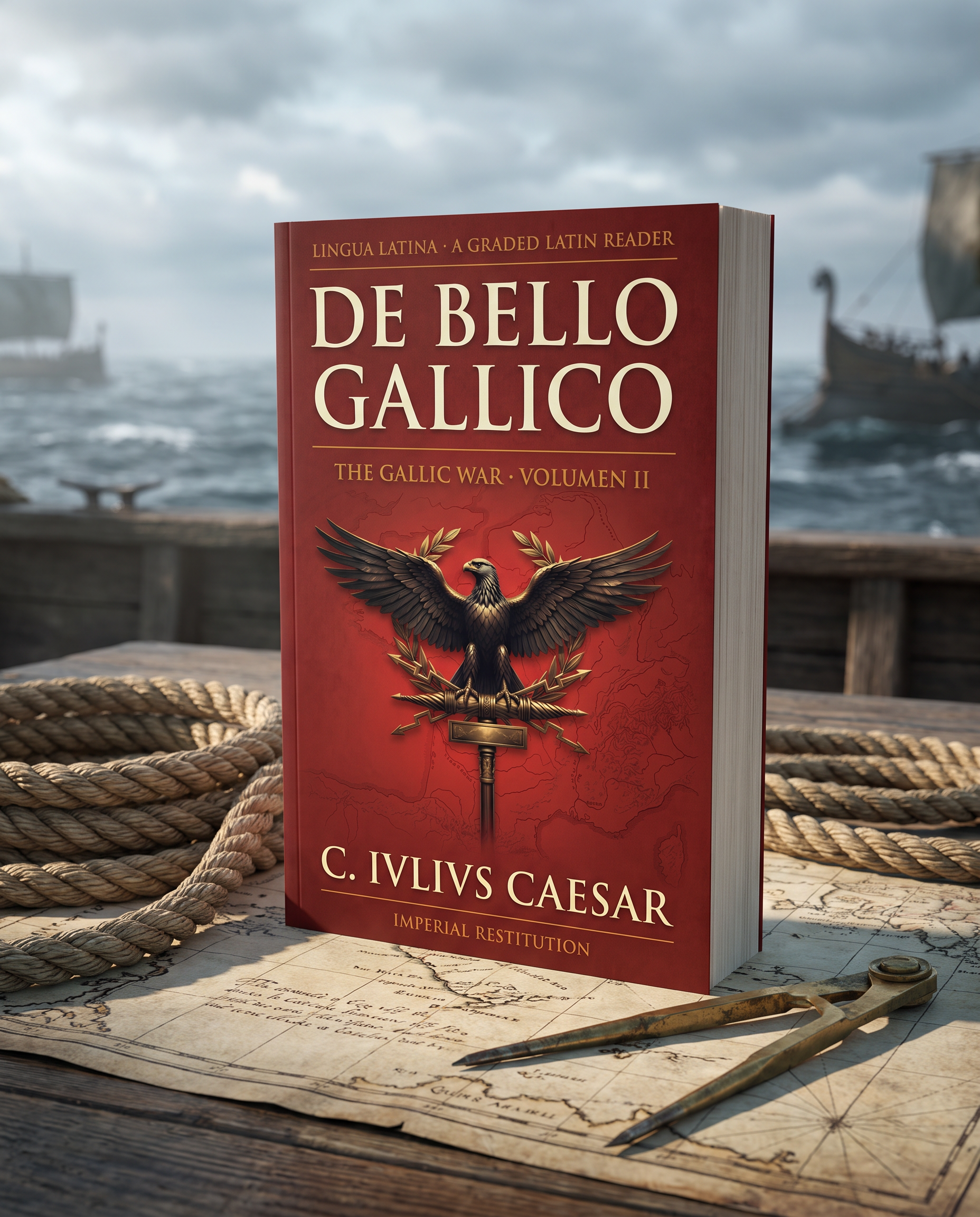
Fere libenter hominēs id quod volunt crēdunt — "men gladly believe what they wish to be true." Caesar wrote that line about the Gauls in 56 BC. In this volume you will read it, and everything around it, in his own language — without a dictionary.
De Bello Gallico — Volume 2 presents Books II, III, and IV of Julius Caesar's Commentarii de Bello Gallico, the Gallic War, as a continuous graded Latin reader. These are the middle books of the war, and they contain some of the most astonishing episodes in all of Roman literature: a general who seizes a shield and fights in the front line, Rome's first naval battle on the open Atlantic, a timber bridge thrown across the Rhine in ten days, and two legions wading ashore under a hail of javelins onto an island the Romans knew only from rumor — Britain.
The story opens in winter quarters, where messengers bring Caesar word that all the tribes of northern Gaul — the Belgae, whom he called the bravest of the Gauls — have sworn a conspiracy against Rome. What follows across twenty chapters is a relentless three-year campaign. The Remi defect and reveal the enemy's staggering numbers: sixty thousand Bellovaci, the Suessiones, and the fierce Nervii, a people so austere they admitted no merchants and drank no wine. At the river Sabis the Nervii spring their ambush from hidden woods while the legions are still digging camp, and for an afternoon everything hangs in the balance — until Caesar himself takes a shield from a soldier in the rear ranks and pushes into the fighting line. At the fortress of the Atuatuci, defenders laugh from the walls at a distant Roman siege tower — until it begins to move toward them.
Book III takes the war to the ocean. The Veneti of Brittany, master sailors with tall oak ships built for Atlantic tides, seize Roman envoys, and Caesar orders an entire fleet built on the Loire. In the bay off Quiberon the Romans answer seamanship with a carpenter's trick: long hooks on poles that slice the enemy's halyards so the great leather sails collapse — and then the wind dies, and the ocean war is decided in a single afternoon. Book IV pushes to the edges of the known world: the massacre at the Meuse confluence (told honestly, including Cato's motion in the Senate that Caesar be handed over to the Germans), the famous ten-day bridging of the Rhine, and finally the opposed landing in Britain, where the standard-bearer of the Tenth Legion leaps alone into the surf shouting "Dēsilīte, mīlitēs, nisi vultis aquilam hostibus prōdere!" — "Jump down, soldiers, unless you want to betray the eagle to the enemy!" A full moon then swells the tide and wrecks the anchored fleet, stranding an army at the edge of the world as winter approaches.
How the Graded-Reading Method Works
This is not a translation and not a textbook. Following the natural method pioneered by Hans Ørberg's Lingua Latina per se Illustrata, every chapter retells one dramatic episode in clear, connected Latin that explains itself as you read. New words — over 550 fresh glosses beyond Volume One — are defined in the margin in Latin, using only vocabulary you have already met, never in English. Extensive dialogue between officers and soldiers recycles new words naturally, the way Ørberg's question-and-answer style makes vocabulary stick. Every word in the book carries full macrons, so you absorb correct vowel quantities — and therefore correct pronunciation and meter — from the first page.
The destination of every chapter is Caesar himself. Each of the twenty chapters ends with the textus originalis: Caesar's actual, unadapted words for that episode, fully macronized. Because the retelling has already taught you the vocabulary and the constructions, by the time you reach the original you can simply read it. This is the promise of the series: not Latin about Caesar, but a staircase that ends inside the real text.
Volume 2 is also where learners cross the single most important grammatical bridge in Latin prose: ōrātiō oblīqua, indirect speech. It is the construction that makes unadapted Caesar feel impossible to first-time readers, and it saturates Books II–IV. This volume introduces it gently in chapter one — nūntiātur omnēs Belgās coniūrāre, "it is reported that all the Belgae are conspiring" — and practices it on every page after, until reported speech reads as naturally as a headline.
Inside the Book
- ✓ 20 illustrated chapters covering Books II–IV complete — the Belgae, the sea war, the Rhine, and Britain — with cinematic full-page artwork
- ✓ Marginal Latin glosses — 550+ new words defined in Latin, building on Volume One's foundation of roughly 630 words
- ✓ Textus originalis at the end of every chapter — Caesar's own macronized words, readable by the time you arrive
- ✓ Hand-styled battle maps — the Aisne, the Sabis, the naval battle off Quiberon, the British coast — plus a cutaway engineering diagram of the Rhine bridge
- ✓ Complete back matter — Persōnae Historicae, biographies in easy Latin of Labienus, young Crassus, Commius, Galba and the rest (including the fates Caesar himself never knew), and a full alphabetical Index Verbōrum
Who This Volume Is For
Readers of Volume One will find the difficulty picks up exactly where the Helvetii and Ariovistus left off — the vocabulary and grammar build seamlessly. Self-learners beyond the beginner stage (after Ørberg's Familia Romana or any first-year course) can also begin here: a summary of the story so far bridges the gap. Homeschool families get a full year of connected, exciting, genuine Latin reading with no English crutch to lean on; teachers and AP Latin students get the fastest on-ramp to fluent sight-reading of Caesar, whose De Bello Gallico anchors the AP syllabus. And returning Latinists who always meant to read the Ocean, the Rhine, and Britannia in the original will find the pain removed and the drama intact.
This series presents the entire Gallic War in graded Latin — the whole epic, not excerpts. Volume One covers Book I; this volume carries Books II–IV; Volume Three concludes with Ambiorix, the druids, Vercingetorix, and the siege of Alesia. All three are also available in a single complete edition. Sequere aquilās trāns Ōceanum — follow the eagles across the Ocean.