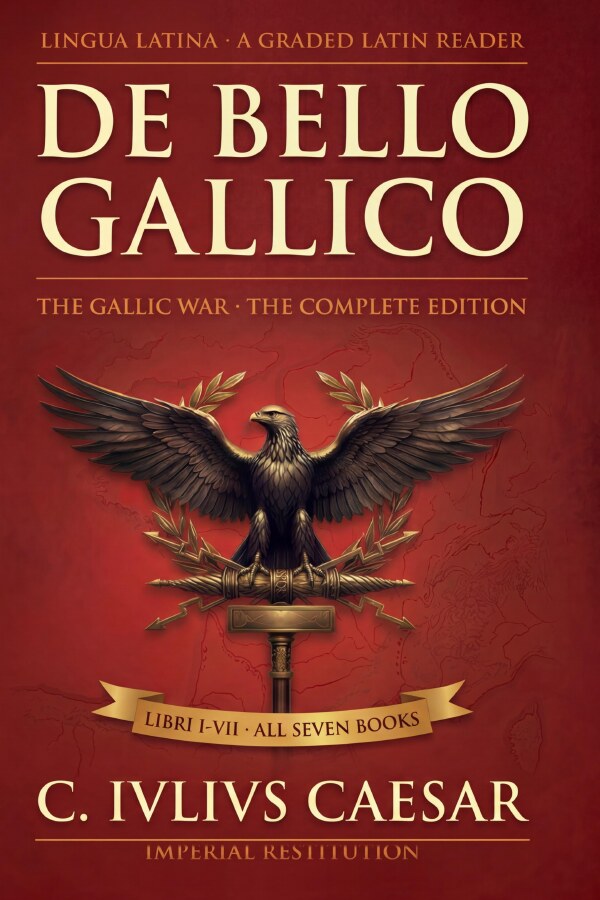
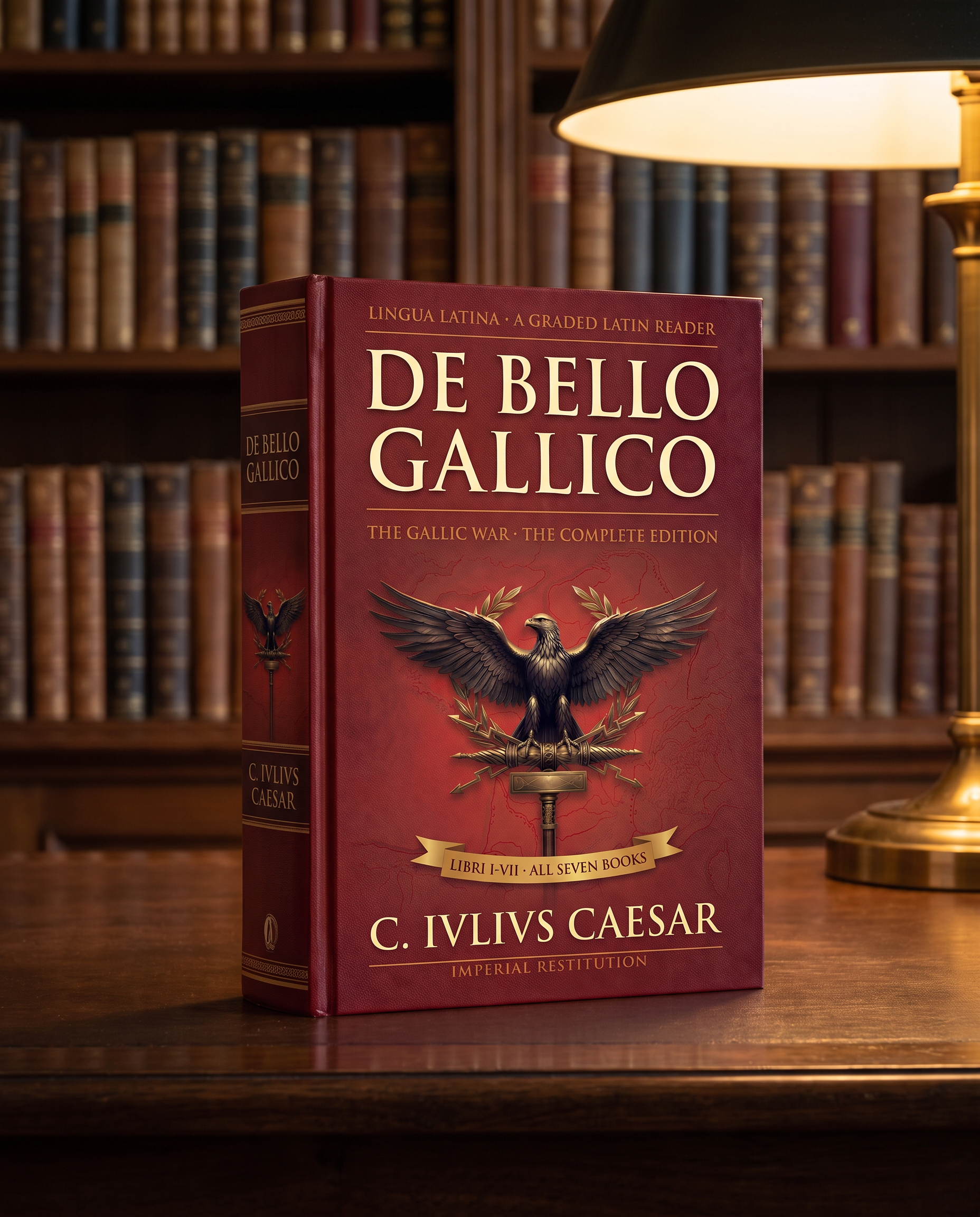
The complete De Bello Gallico — Caesar's own account of the conquest of Gaul — bound as a single graded Latin reading course of 62 chapters and more than 700 pages.
Between 58 and 50 BC, Julius Caesar subdued Gaul, bridged the Rhine, crossed the Ocean to Britain twice, lost a legion to treachery, suffered his one open defeat at Gergovia, and ended a nation's bid for freedom in the double siege ring of Alesia. He then wrote it all down himself, in a Latin so clean and forceful that it has been the standard first author for Latin students for five centuries. This edition gathers our entire three-volume Lingua Latina adaptation of that work into one tome: the whole war, Books I through VII, with an epilogue carrying the reader to Book VIII (finished by Caesar's officer Aulus Hirtius) and beyond — the Rubicon, the triumph of 46 BC, and the end of Vercingetorix.
One Continuous Course, from First Page to Alesia
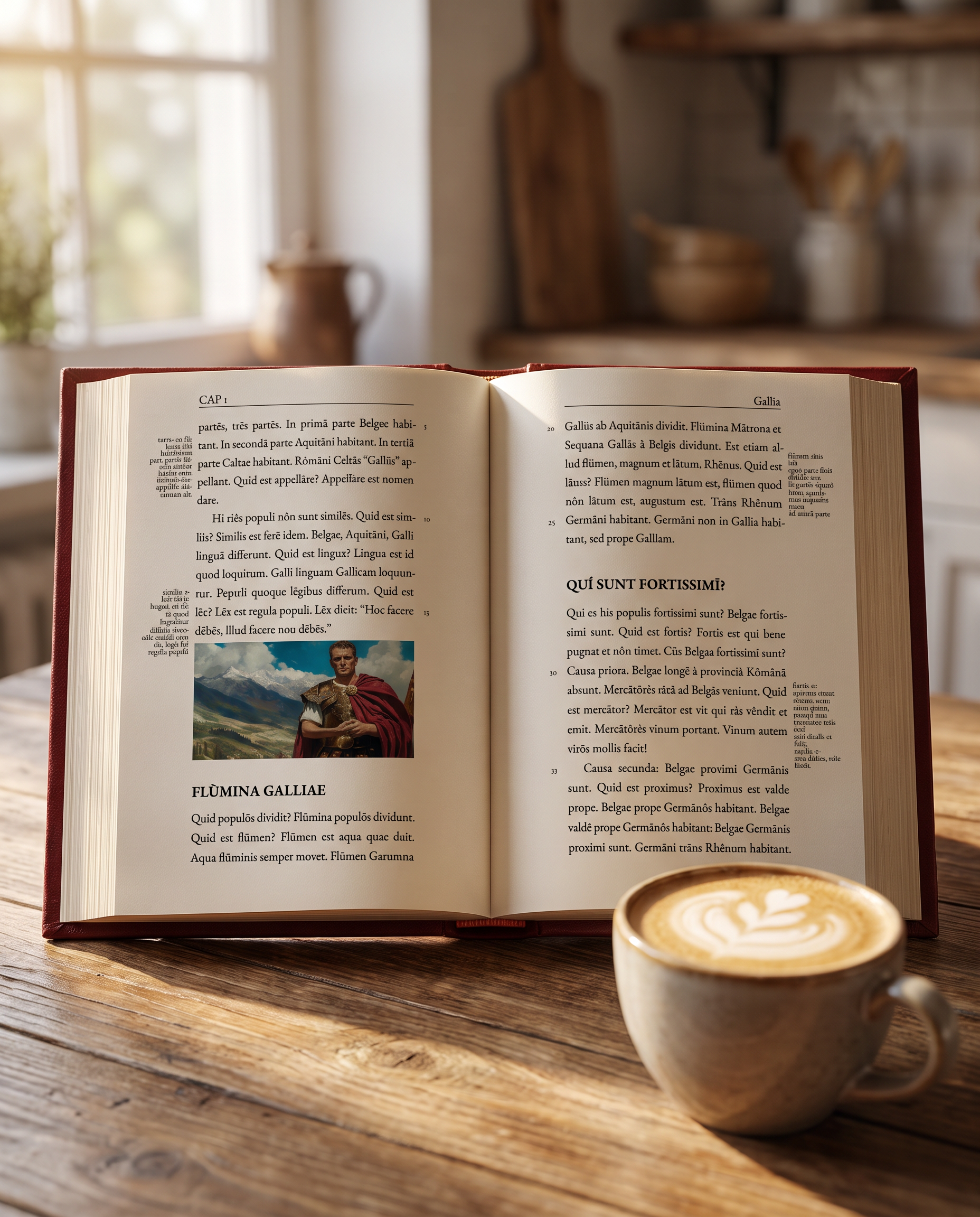
This is not an anthology of excerpts. It is a single, carefully engineered ascent. The reader who can only just parse Gallia est omnis dīvīsa in partēs trēs — the most famous opening line in Latin literature — is, seven hundred pages later, reading Caesar's unmodified prose without help. The method is the one pioneered by Hans Ørberg's Familia Romana and proven across our Strategemata trilogy: every one of the more than 1,650 new words introduced across the course is explained in Latin, in the margin, exactly once. There are no English translations anywhere in the book, no glossary of English meanings, no dictionary required. Macrons mark vowel length throughout, so you absorb correct pronunciation and morphology from the first sentence. Grammar is never drilled; it is scaffolded. Indirect statement, ablative absolutes, gerundives, and long subjunctive chains enter the story gradually, each one readable in context before it is ever frequent.
Crucially, the adapted Latin converges on the real thing. Every chapter closes with a passage of Caesar's original, unadapted text, so the distance between "reader Latin" and Caesar shrinks measurably as the book proceeds — until, by the final book, there is essentially no distance left.
What Happens in the Book
Volumen I (Book I and the opening campaigns) begins with the migration of the Helvetii — an entire people burning their own towns and marching west — and Caesar's race to stop them, then the confrontation with Ariovistus, the German king who answers Roman diplomacy with menace. The foundation chapters teach by story: Quid est flūmen? Flūmen est aqua quae fluit — and by the end of the first part you are reading real campaign narrative.
Volumen II escalates: the massed conspiracy of the Belgae, the near-disaster on the Sabis where Caesar had to grab a shield and fight in the front line, the sea war against the Veneti and their oak-hulled Atlantic ships, the bridge thrown across the Rhine in ten days as a feat of pure engineering intimidation, and the first Roman landings on the beaches of Britain.
Volumen III is the darkest and greatest stretch of the work. Britain again, and a storm that wrecks forty ships. The catastrophe of Ambiorix: fifteen cohorts talked out of their winter camp and annihilated in a forest defile, the eagle-bearer hurling his standard over the rampart so it would not be taken. The siege of Quintus Cicero's camp and the rivalry of the centurions Pullo and Vorenus, who save each other's lives while competing for glory. Caesar's famous ethnographic digressions — the druids and their twenty-year schools, the wicker figures, the endless Hercynian forest with its elk and aurochs. And then Vercingetorix: the scorched-earth arithmetic that burned twenty towns in a day, the eighty-foot siege terrace at Avaricum built in freezing rain, the defeat at Gergovia told with unusual honesty, and finally Alesia — eleven miles of inner wall, fourteen of outer, twenty-three forts, the terrible speech of Critognatus inside the starving town, Caesar's scarlet cloak visible to both armies at the crisis, and the surrender scene in which a king casts his armor at the feet of a proconsul in silence.
Illustrated Like a Campaign Should Be
The edition carries more than 60 full-page cinematic plates, antique-style campaign maps, and hand-drawn battle diagrams — including the engraved plan and cross-section of the Alesia siege works, labeled entirely in Latin, down to the soldiers' black-humor names for the trap field: cippī, līlia, stimulī. Back matter includes Persōnae Historicae — the afterlives of the war's principal figures, from Orgetorix to Caesar himself, told in Latin — and a merged Index Verbōrum of over 1,650 entries covering the entire course.
Who This Edition Is For
Homeschool families get a complete multi-year Latin literature program in one purchase: a course that starts gently, never requires a separate dictionary or answer key, and ends at genuine classical Latin. AP Latin students read Caesar for half of the AP syllabus; this edition builds the reading fluency the exam actually tests — comprehension at speed, in Latin — before the student ever confronts the set passages cold. Self-taught Latinists who have finished Familia Romana or an equivalent and want real literature, not another textbook, will find this the natural next step. And classical schools tend to choose this volume over the separates for the simple reason that one spine survives a classroom better than three.
The three volumes are also available separately — begin with Volume I if you prefer smaller books — but this Complete Edition exists for readers who want the whole campaign in hand at the best price per page in the series. When you finish it, the Lingua Latina path continues into poetry with the Aeneis, the Vergil half of the AP pairing, and Ovid's Metamorphoses.
Ūna aestās, ūnum bellum, ūnus liber. Sequere aquilās.
— One summer, one war, one book. Follow the eagles.