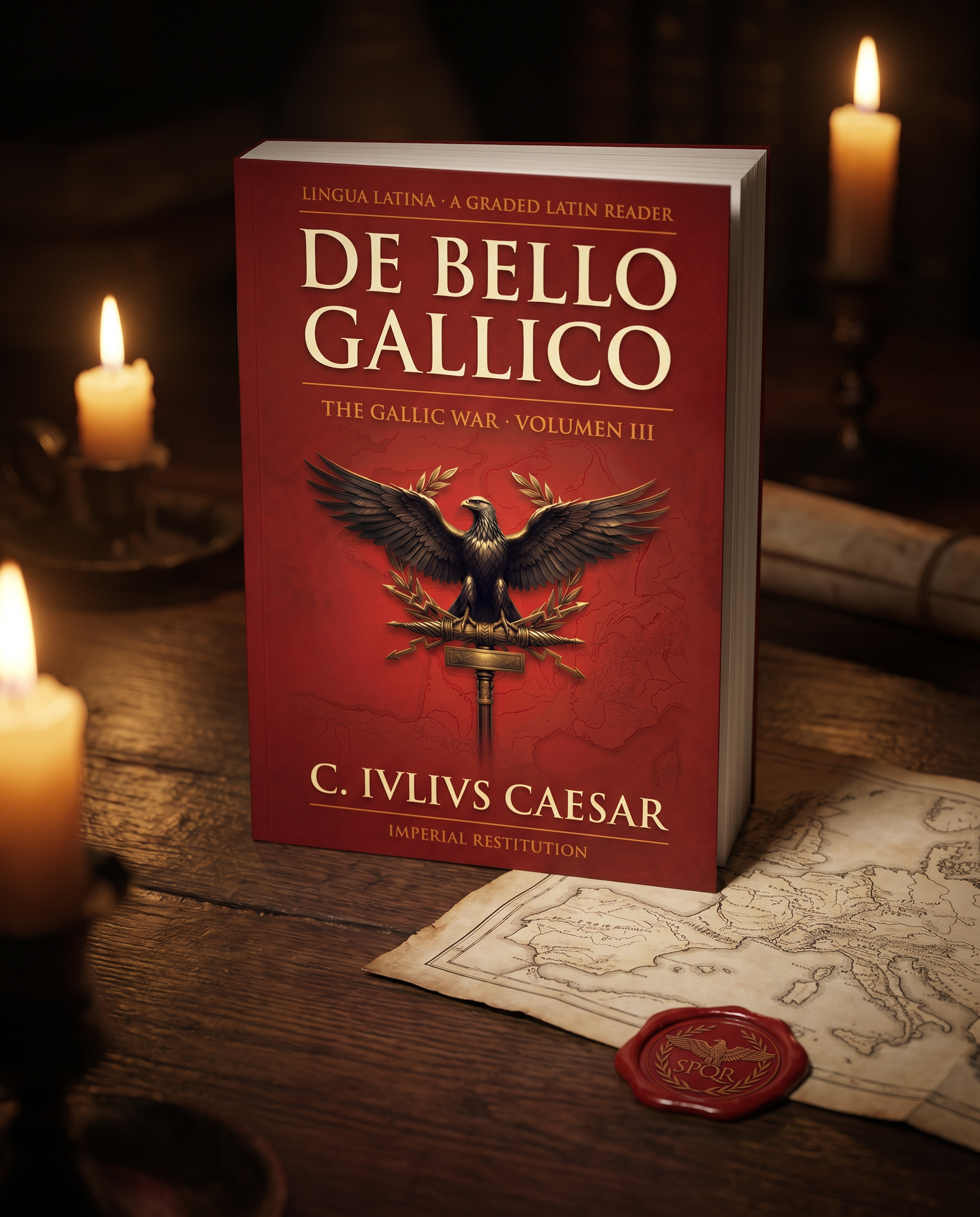
The fall of free Gaul is the most dramatic stretch of military narrative antiquity ever produced. This volume lets you read it in Latin — and actually understand it.
De Bello Gallico, the Gallic War, is Julius Caesar's own account of his conquest of Gaul between 58 and 50 BC — seven books of first-hand war reporting written by the general who fought it, in prose so clean that Latin teachers have put it in front of students for two thousand years. Volume 3 of this illustrated graded-reader edition covers Books 5 through 7, the climax of the whole work: the second invasion of Britain, the destruction of a Roman army in a snowbound valley, Caesar's strange and fascinating ethnography of the druids and the German forests, and finally the great revolt of all Gaul under Vercingetorix, ending at the double siege walls of Alesia.
Like Volumes 1 and 2, this is not a translation and not a grammar textbook. It is the story itself, retold in fluent, carefully graded Latin — every word macronized, every new word glossed in Latin in the margin — that rises chapter by chapter toward Caesar's own unmodified text.
What Happens in This Volume
Liber V opens with a fleet of eight hundred purpose-built ships mustering at Portus Itius for the second British expedition — and with the chieftain Dumnorix riding out of camp to his death, shouting that he is a free man of a free state. Across the Channel: chariot country, the ford of the Thames, and the submission of Cassivellaunus. Then the mood turns black. Back in Gaul, Ambiorix lures fifteen cohorts out of their winter camp after an all-night debate between the legates Sabinus and Cotta — readers of Volume 2 already know Sabinus's fatal flaw — and annihilates them in a defile. The aquilifer Petrosidius hurls the eagle over the rampart before he dies. The book closes with the siege of Quintus Cicero's camp and the rivalry of the centurions Pullo and Vorenus, the single most cinematic scene Caesar ever wrote, before a forced march and a baited trap bring Caesar's relief.
Liber VI is Caesar the ethnographer: the druids' twenty-year school of memory, souls that do not die, the wicker figures of human sacrifice, a calendar that counts nights before days — and then the endless Hercynian forest, sixty days' march across, with its elk and aurochs described by a Roman who is only half sure he believes his sources. The manhunt for Ambiorix ends with the veteran centurion Baculus rising from his sickbed one last time to hold a gate, and with Ambiorix vanishing into the forests forever.
Liber VII is the finale everything has been building toward. News of the massacre at Cenabum travels a hundred and sixty miles by shouted relay in a single day, and a young exiled nobleman named Vercingetorix makes himself king of the Arverni and commander of a united Gaul. His strategy is terrible arithmetic: burn everything, twenty towns of the Bituriges in one day, so that Rome starves. You will read the siege terrace of Avaricum built in twenty-five days of freezing rain, Caesar's one open defeat at Gergovia told with unusual honesty, Labienus's night escape across the Seine, and then Alesia itself — eleven miles of inner wall, fourteen of outer, twenty-three forts, and a trap field the legionaries named with black humor: cippī, līlia, stimulī. Inside the walls, Critognatus delivers the most dreadful speech Caesar ever recorded. On the last day, Caesar's red cloak appears on the rampart, visible to both armies, and the fight for the liberty of Gaul is decided in a single afternoon. The final chapter is four quiet words: Vercingetorix rides out, casts his armor at Caesar's feet, and sits in silence.
"Dē lībertāte Galliae ūnō diē pugnātum est." — On a single day the battle was fought for the freedom of Gaul.
— Chapter 21, Proelium Ultimum
How the Graded-Reading Method Works
This series follows the comprehensible-input tradition of Hans Ørberg's Lingua Latina per se Illustrata: everything on the page is Latin, and the page itself teaches you to read it. Each of the 22 chapters retells a section of Caesar's narrative in graded prose with long vowels marked (macrons) throughout. New vocabulary — 586 entries in this volume, deliberately never repeating the roughly 1,200 words already taught in Volumes 1 and 2 — is glossed in the margin in Latin, using pictures, synonyms, and the constant Quid est...? scaffolding the series is built on. There are no English translations anywhere in the book.
Because this is the third volume, the training wheels are coming off. Indirect speech (ōrātiō oblīqua), taught step by step in Volume 2, now flows freely from the first chapter; gerundives, ablative absolutes, and long subjunctive chains appear as Caesar wrote them, scaffolded but untranslated. Each chapter converges on a passage of Caesar's genuine, unmodified text — so by the final page you are no longer reading a reader. You are reading Caesar cold.
The volume is illustrated throughout with full-page photorealistic plates — the storm-wrecked beach in Britain, the druids' grove, the burning towns at night, the red cloak at Alesia — plus an antique-style campaign map of Gaul in revolt and a detailed engraved plan and cross-section of the Alesia siege works, the most famous fortification in military history, labeled entirely in Latin. Back matter includes Persōnae Historicae, short Latin lives tracing what became of Vercingetorix, Ambiorix, Commius, Labienus, Baculus, and Caesar himself, and a complete index of every glossed word.
Who This Book Is For
This volume is written for readers who have finished Familia Romana or an equivalent first course and want real Roman prose with support that gradually disappears: homeschool families teaching Latin without a translation crutch, self-taught adult Latinists, and teachers looking for serious post-LLPSI reading material. Students preparing for advanced Latin coursework will find the material directly relevant — Book 6, with its famous druid ethnography, remains one of the teacher's-choice selections on the redesigned AP Latin syllabus, and this volume covers it in full.
The intended reading path: start with Volume 1 (Book 1, the Helvetii and Ariovistus), continue through Volume 2 (Books 2–4, the Belgae, the sea peoples, the Rhine bridge, and the first landing in Britain), and finish here. Readers coming from our Strategemata trilogy will find the level continuous with Strategemata III. All three Caesar volumes are also available as a single complete edition. Browse the full Lingua Latina collection for what comes next — Vergil's Aeneid and Ovid's Metamorphoses await.