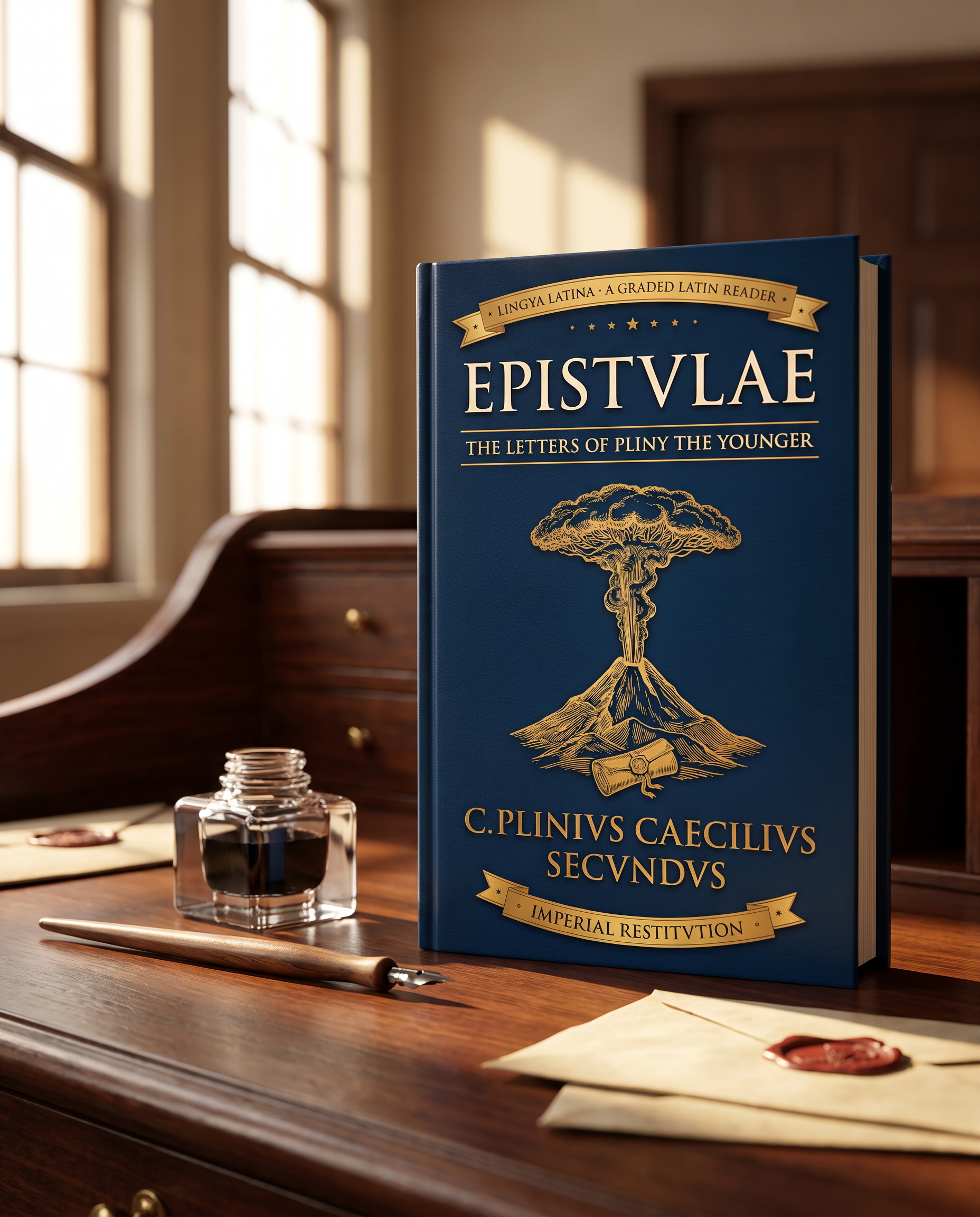
In August of 79 AD, a seventeen-year-old boy sat reading at Misenum while a cloud shaped like an umbrella pine rose over the Bay of Naples. Years later, at the historian Tacitus's request, he wrote down what he saw. His two letters are the only surviving eyewitness account of the eruption that buried Pompeii — and in this book, you will read them in Latin.
Pliny the Younger — Gaius Plinius Caecilius Secundus — was a lawyer, senator, and eventually governor of Bithynia under the emperor Trajan. But he is remembered for his letters: 368 of them, polished for publication, covering everything a curious Roman noticed. A boar hunt conducted with a stylus and notebooks instead of a spear. A three-line guilt trip to a friend who never writes back. A haunted house in Athens where a ghost rattles its chains until a philosopher follows it into the courtyard. A tame dolphin at Hippo that carries a boy across the harbor. Love letters to his young wife Calpurnia. A petition to an emperor for an aqueduct. Where Caesar gives us Rome at war, Pliny gives us Rome at home — dinner parties, lawsuits, grief, ghosts, and one very famous volcano.
How the Graded Method Works
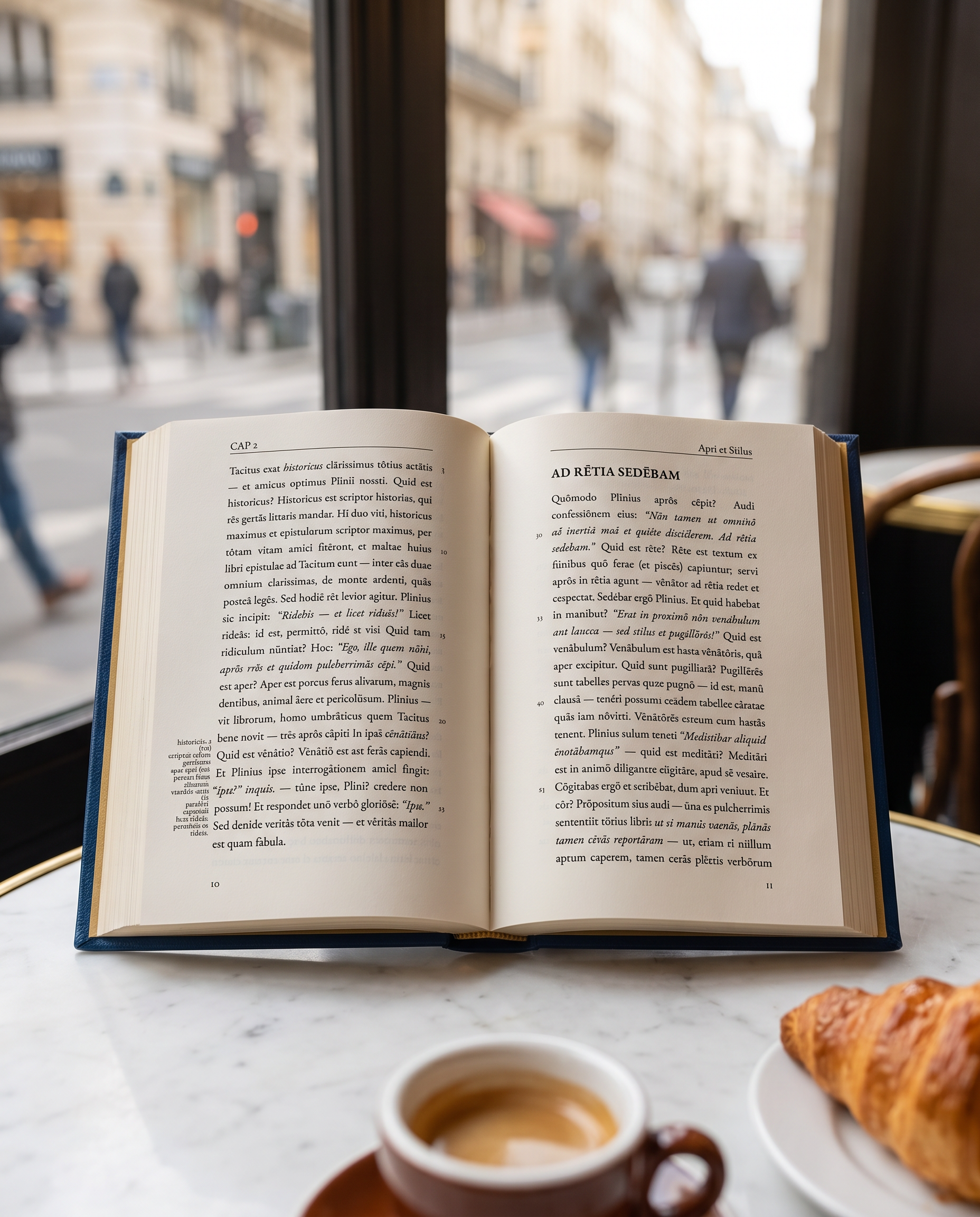
Epistulae is the fourth volume in our Lingua Latina series, and it follows the same principle as the others: you learn Latin by reading Latin. There is no English inside the book. Each of the 22 chapters retells one or more of Pliny's letters in easy, natural Latin, with every new word glossed in the margin — in Latin, the Ørberg way — exactly once. Macrons mark every long vowel throughout, so you absorb correct pronunciation and morphology as you read. The story carries you; the apparatus stays out of the way.
Then comes the payoff that defines this series: every chapter ends with the complete, unabridged original letter in Pliny's exact words. You meet each text twice — first retold at your level, then straight from the author's hand. Because letters are short and self-contained, this volume can do something the longer prose works cannot: more than twenty complete works of Latin literature, read whole, cover to cover. The chapters are sequenced by difficulty rather than by book number, so the easiest delights come first and Pliny's most demanding prose arrives when you are ready for it.
This volume also opens its own vocabulary world from the first page — roughly 600 words, glossed from zero. You do not need to have read our Caesar or Frontinus volumes first: Epistulae stands alone as an entry point, and Chapter 1 begins by teaching the Roman letter itself — what C. PLĪNIUS TACITŌ SUŌ S. means, how a letter opens and closes, why every one ends with VALĒ — using the very first letter of Pliny's collection, the preface in which he explains why he published his correspondence at all.
Every AP® Latin Letter, Complete
The revised AP Latin syllabus pairs Vergil's Aeneid with a set of Pliny's letters — and every one of them is in this book, unabridged: the love letters to Calpurnia (6.4 and 6.7), the haunted-house letter (7.27), both Vesuvius letters to Tacitus (6.16 and 6.20), and the full Trajan correspondence, from the citizenship petitions for Pliny's Egyptian doctor (10.5–7) to the aqueduct file for Nicomedia (10.37–38 and 10.90–91), with the emperor's replies. AP chapters are marked with a discreet marginal device, and each tested letter appears twice — once retold in graded Latin, once in the exact original — so students walk into the exam having genuinely read the text, not merely decoded it.
What Happens in the Book
The 22 chapters run in four parts. EPISTULA teaches the form through Pliny's lightest material: the boar hunt, the skipped chariot races (Pliny cannot understand why grown men care which color wins), the sacred spring of Clitumnus, the dolphin of Hippo, and a full tour of his seaside villa at Laurentum — accompanied by an engraved bird's-eye reconstruction of the villa, labeled entirely in Latin. HOMINĒS turns to people: Calpurnia, the death of Fundanus's young daughter, Pliny's humane anxiety over his sick slaves and freedmen, the delicious villainy of the legacy-hunter Regulus, and the ghost in chains. VESUVIUS gives the AP core four full chapters: the strange cloud, the elder Pliny's fatal rescue voyage, the earthquakes at Misenum where the sea withdraws from the shore, and the darkness at noon in which mothers cannot find their children. TRĀIĀNUS closes with the governor writing to his emperor — citizenship, aqueducts, and, beyond the exam, the famous exchange about the Christians of Bithynia (10.96–97), one of the most consequential administrative letters ever written — before a farewell chapter follows Pliny through a single day at his Tuscan villa.
The apparatus is complete: 22 full-page cinematic plates, an antique-style map of the Bay of Naples in 79 AD, PERSŌNAE HISTORICAE — eleven short Latin lives, from Pliny's mother to Trajan himself — and a 384-entry INDEX VERBŌRUM.
Who This Book Is For
AP Latin students and their teachers will find the entire required Pliny here, scaffolded twice over. Homeschool families get a self-contained course in real Roman prose whose subject matter — family, letters, houses, weather, wonder — needs no military glossary. Self-taught Latinists who finished Familia Romana and want authentic voices will find Pliny the friendliest of all classical authors: short texts, warm personality, complete works. And readers of our Dē Bellō Gallicō volumes get the perfect counterweight — after seven books of war, an empire at peace.
"Scrīptor tam diū vīvit quam diū legitur." — A writer lives as long as he is read.
— the motto of this volume