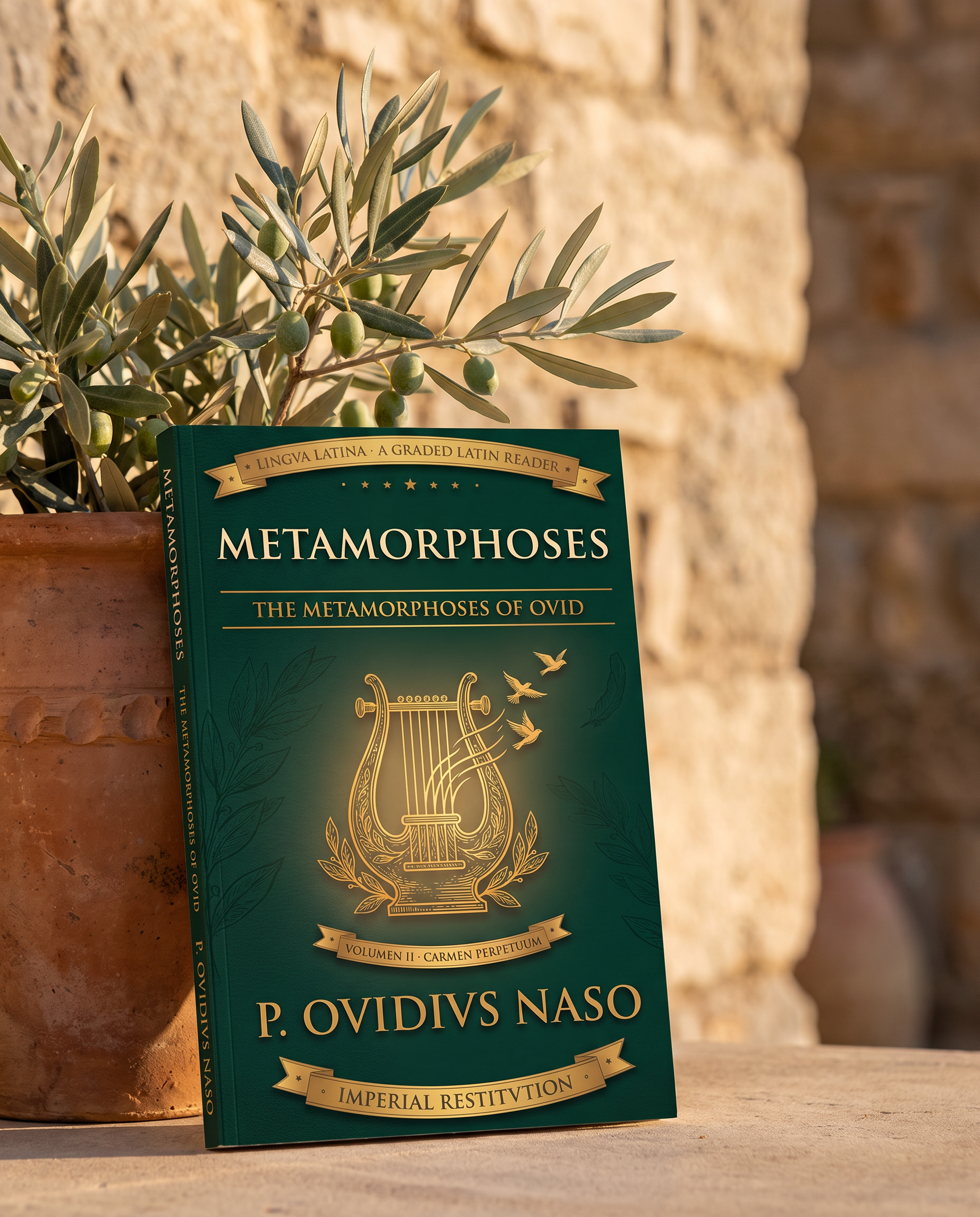
Read Ovid. In Latin. No dictionary required.
Around the year 8 AD, Publius Ovidius Naso finished the most ambitious poem Rome ever produced: the Metamorphoses, a "perpetual song" (carmen perpetuum) that runs in one unbroken thread from the creation of the world to the poet's own day. Its subject is transformation — gods becoming bulls, girls becoming trees, grief becoming birdsong — and its closing lines make a transformation claim of their own: that the poet, carried above the stars by his work, will be read wherever Roman power reaches, and will live. Vīvam — "I shall live" — is the last word of the epic. This volume ends there, and by the time you reach it you will be reading that promise in Ovid's own hexameters, unabridged.
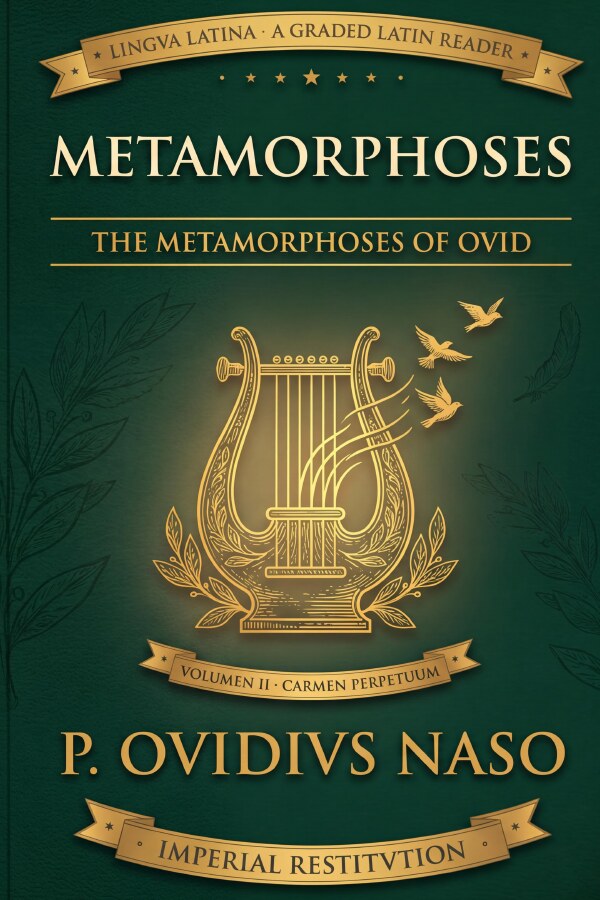
Volume II: Carmen Perpetuum is the second half of our two-volume graded edition of the Metamorphoses. Volume I carried the story from Chaos and the flood to Arachne's weaving contest; this volume picks up exactly where Ovid himself pivots — with Niobe, who knew Arachne and learned nothing from her fate — and follows the poem's own order through twelve complete myths to the finale in Book XV. Nothing is excerpted or chopped into disconnected snippets: each chapter retells one whole myth, and bridge sentences carry Ovid's own transitions between them, so the book reads the way the poet designed his epic to read — as one continuous story.
What Happens in Volume II
These are the myths that shaped two thousand years of Western art, told whole. Niobe boasts of her fourteen children and watches Apollo and Diana take them all. Medea works her dark arts for Jason — the fire-breathing bulls, the dragon's teeth, the sleepless serpent. Daedalus builds wings of feathers and wax, warns his son, and watches Icarus fly toward the sun and fall into the sea that took his name. The gods knock, disguised, at a thousand rich doors and are turned away — until old Philemon and Baucis welcome them into a poor cottage, steadying the wobbly table with a potsherd. Erysichthon takes an axe to a sacred oak and is given a hunger nothing can fill. Hercules dies in the poisoned shirt and rises from the pyre as a god.
Then comes the poet's own territory: Orpheus sings the underworld to a standstill, wins Eurydice back, and loses her with a single look. Pygmalion carves an ivory girl and feels the ivory warm to flesh beneath his fingers. Atalanta, who outruns every suitor, stoops three times for golden apples. Midas turns his food, his wine, and everything he loves to gold — and, given a second chance, earns himself the ears of an ass. Ceyx drowns in a storm and Alcyone, transformed, becomes the halcyon that calms the winter sea. And in the final chapter, Pythagoras teaches that everything changes and nothing dies, Caesar's soul ascends as a comet, and Ovid makes his claim on eternity — followed by an epilogue found in no other reader: the poet's exile to the Black Sea, the mysterious carmen et error that caused it, and the epitaph he wrote for himself, which you, taught Latin by Ovid, are asked to speak aloud.
How the Graded Method Works
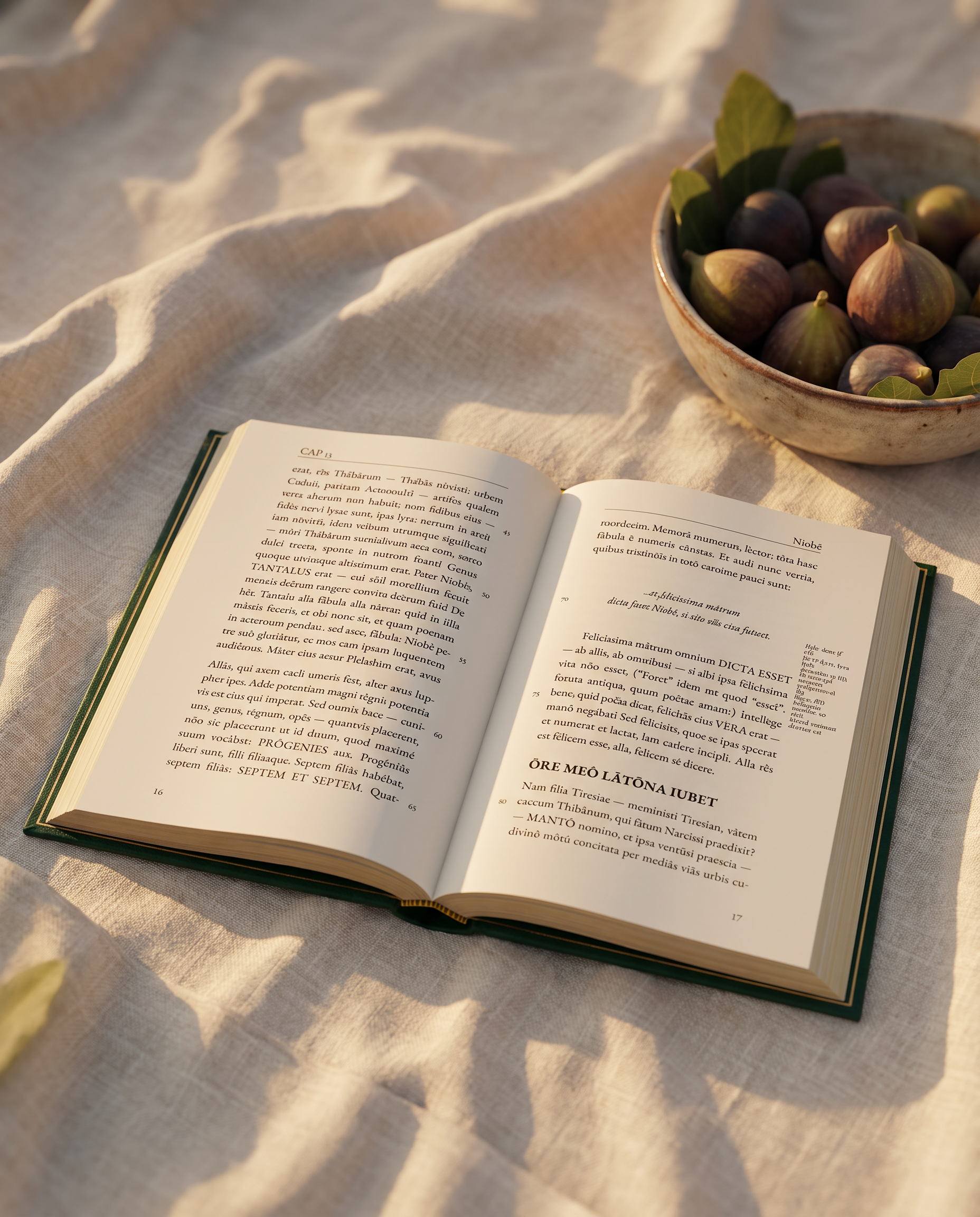
This is real Latin from the first page — not translation, not a textbook with English explanations. The stories are retold in clear, carefully graded Latin prose in the tradition of Hans Ørberg's Lingua Latina per sē Illūstrāta: every new word is explained in Latin, in the margin, at the exact moment you meet it. Every word in the book carries its macrons, so you absorb correct vowel quantities — the skeleton of Latin poetry — from the start. Where a picture teaches faster than a definition, an engraved marginal illustration does the work: the golden apples, the potsherd under the table, the poppies at the door of the House of Sleep.
The book converges on Ovid himself. Every chapter culminates in a Textus Orīginālis: the famous hexameters quoted at the very moment the story reaches them, fully macronized, so the graded prose delivers you to the real verse already understanding it. Ovid's transformations are the pedagogical jewel — he describes change limb by limb, wax softening, fingers curving into claws, hair stiffening into leaves, which makes the poetry astonishingly concrete Latin to learn from. A condensed verse primer opens the volume and teaches you to hear the dactylic hexameter, and a one-page Latin recap of Volume I (Quod ante āctum est) means you can begin here if you wish. The learner's apparatus is complete: a full word index with Latin definitions, a Persōnae Fābulārum cast review, and morally rich tū iūdicā moments — was Orpheus wrong to look back? — that turn reading into thinking in Latin.
Who This Book Is For
Volume II is for readers of Volume I ready for deeper water, and for self-learners past the basics — roughly Familia Romana level or equivalent. Homeschool families get a full year of connected mythology reading in real Latin; teachers get twelve complete myths that can each stand alone in a classroom; exam students meeting Ovid at sight get the fastest possible on-ramp to his verse, including school-canon episodes like Daedalus and Icarus. And because these are the myths everyone half-knows already, the stories themselves carry you through the language: you always know roughly where you are, which is exactly what comprehensible input requires.
In the series reading path, the Metamorphoses volumes follow Caesar's Dē Bellō Gallicō and Pliny's Epistulae, and pair naturally with Vergil's Aenēis — the same meter, a very different music. If you want all twenty-four myths from Creation to Vīvam in a single tome, the Ēditiō Complēta gathers both volumes into one book.
"Iamque opus exēgī... parte tamen meliōre meī super alta perennis astra ferar... vīvam."
— Ovid, Metamorphoses XV — the closing lines, read complete in this volume