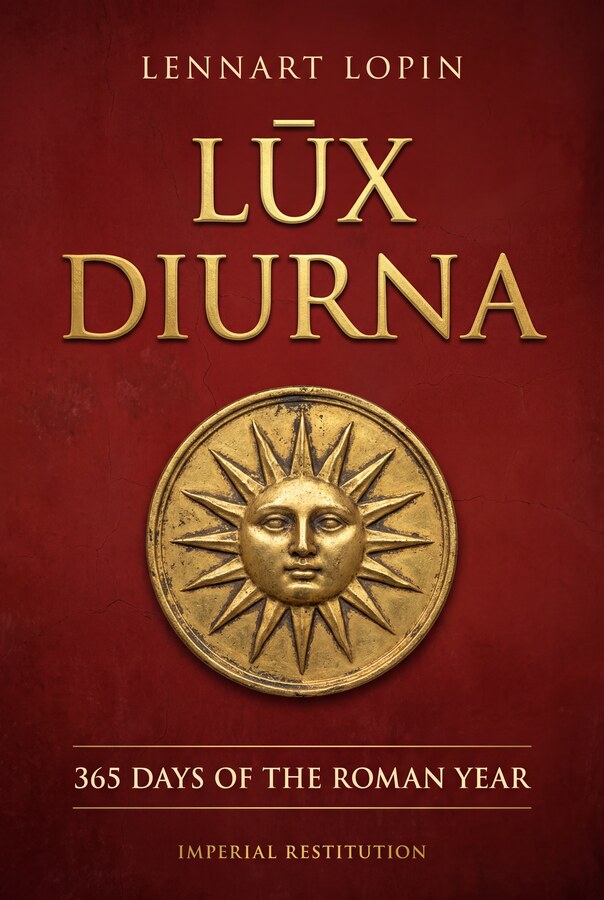
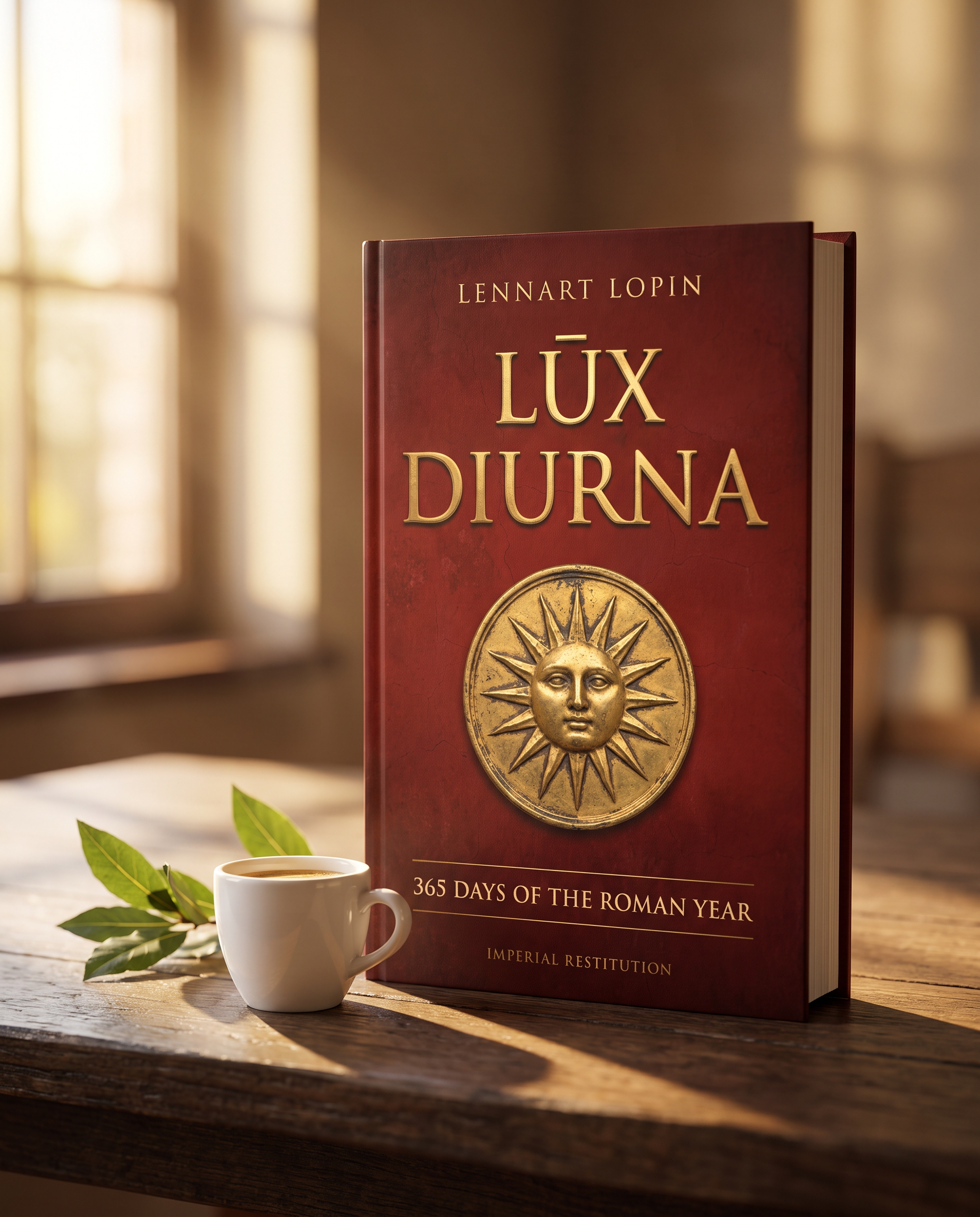
Open this book to today's date and you are standing in Rome.
The page gives you the Roman date, the day's festival, the work under way in the fields, and one line from a Roman author chosen for that day: Seneca on time, Cato on the farm, Ovid on the gods, Plautus on everything else. Lūx Diurna — "the daily light" — is not a quote-a-day book with dates attached. It is the Roman year itself brought back: the Kalendae, the Nōnae, the Īdūs, the real festivals, and the sacred rhythm of the pre-Christian European year, with a page of Roman wisdom for every day of it. There are 366 day pages in all — the leap day, the Roman bis sextum, gets a page of its own.
"The year is a wheel. Step on anywhere."
— from the introduction
Every Page Speaks Three Times
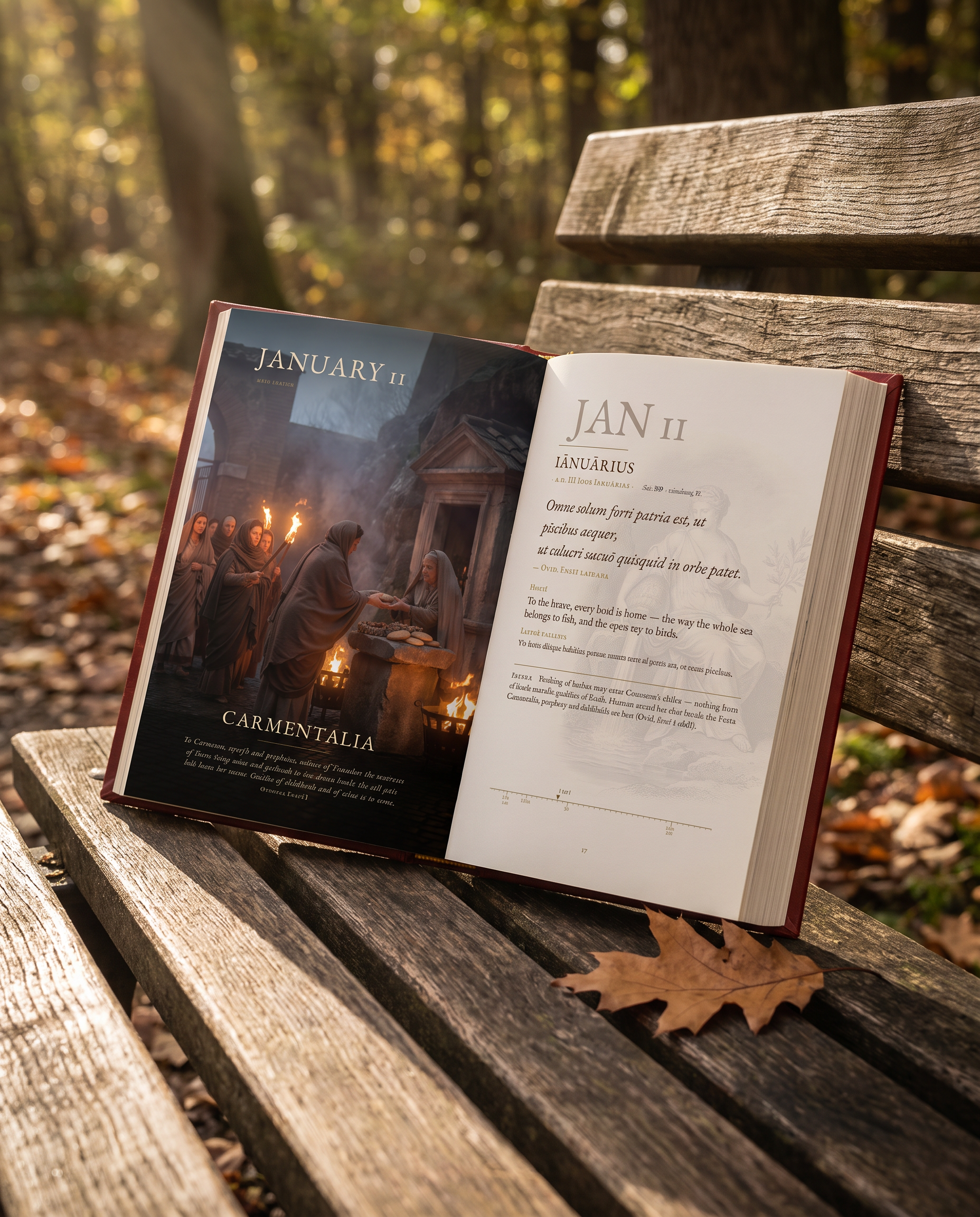
Each day carries one thought in three voices. First, LATĪNĒ: the original line exactly as its author wrote it, with long vowels marked throughout — carpe diem, yes, but also Seneca's asthma letter, Catullus' sparrows and suns, the tomb inscriptions, the legal maxims, the one-liners of Publilius Syrus. Second, HODIĒ: the same thought in the English you actually speak — short sentences, no translationese, no poetry-voice; the test for every rendering was whether you would say it out loud to a friend. Third, LATĪNĒ FACILIUS: the thought said once more in Latin simple enough for a beginner, in the graded style our readers of Caesar, Vergil, and Ovid already know. A line a day like this, and by December the language begins to stick — the easy-Latin column quietly amounts to a full year of graded reading practice.
The Roman Year, Restored
The calendar is the spine of the book. Every month opens with a full-page plate and an essay on the month itself — why the year begins with two-faced Janus, why March opens the war season — together with the month's menologium, the farmer's stone almanac, rendered as the Romans carved it: the days, the daylight hours, the sun's sign, the tutelary god, the farm work, the chief festivals. Every day page carries the Roman date beside the modern one, the old day-letter and market-letter from the stone calendars, and — at the foot of the page — a measuring-line of the whole month with today marked on it, so that the backward-counting Roman date is not explained once and forgotten but seen every single day. By the end of the year you read ante diem quārtum Nōnās Februāriās as natively as "February 2nd." No other book teaches this skill, because no other book gives you 365 chances to absorb it.
Festival days get the full treatment. Twelve of the year's great feasts receive photographic full-page plates facing their day: the Lupercalia's runners in February, the Parilia bonfires on Rome's own birthday (April 21st), the ghost-nights of the Lemuria with their midnight bean-rite, the Neptunalia in the July heat, the Vulcanalia's dusk fires, the October Horse by the Tiber, and the Saturnalia — which gets a full week of expanded entries, December 17th through the 23rd, as the year's crescendo. Around the quotes, rotating layers deepen the day: HŌC DIĒ marks what happened on this date in antiquity (January 10th, Caesar crosses the Rubicon; August 2nd, Cannae; September 2nd, Actium; the Ides of March need no introduction), and OPERA ANNĪ tells you what Romans were actually doing this time of year, drawn from Columella's day-by-day farm calendar — when the sowing opens, when the sailing season begins, when the Pleiades set. At the year's hinge points, boxed notes trace the parallels to the wider pagan European year: Saturnalia and Yule, the February cleansings, the ancestor nights — sourced from Bede and Tacitus, and clearly labeled as parallels rather than mashed into the Roman material.
Accuracy as a Feature
Every quotation in the book was checked word for word against its source text. The daily-wisdom shelf is notoriously full of misattributions; here, the famous lines that could not be verified stayed out, however beloved. Where an ancient date rests on tradition rather than proof, the page says so honestly in a note. The calendar grid itself — day-letters, market-letters, the capital-letter festivals — was verified against the epigraphic record through the standard scholarly editions, and where the stone calendar carved at Praeneste preserves its ancient commentary on a festival, the page quotes the stone itself. The sources span a thousand years of the city: Seneca, Publilius Syrus, Ovid, Horace, Cicero, Vergil, Catullus, Martial, Lucretius, Tacitus, Sallust, Juvenal, Pliny the Younger, Cato, and thirty more.
Who This Book Is For
Four doors lead into the same book. Readers of the Daily Stoic who want the real thing, with receipts. Latin learners and homeschool families, for whom the easy-Latin column and the daily calendar line add up to a gentle year-long course that pairs naturally with our graded readers. Lovers of Roman history, who get the deeds, the festivals, and the farmer's year day by day. And anyone drawn to the old European year and its wheel of festivals — the book restores the knowledge and lets the reader decide what it means. Nothing in it needs to be believed; everything in it is real.
Lūx Diurna arrives in Winter 2026 in a full-color paperback, a premium hardcover gift edition, and — a first for the series — a Kindle edition. If you would like to know the moment it is available, leave your name on the notification list.