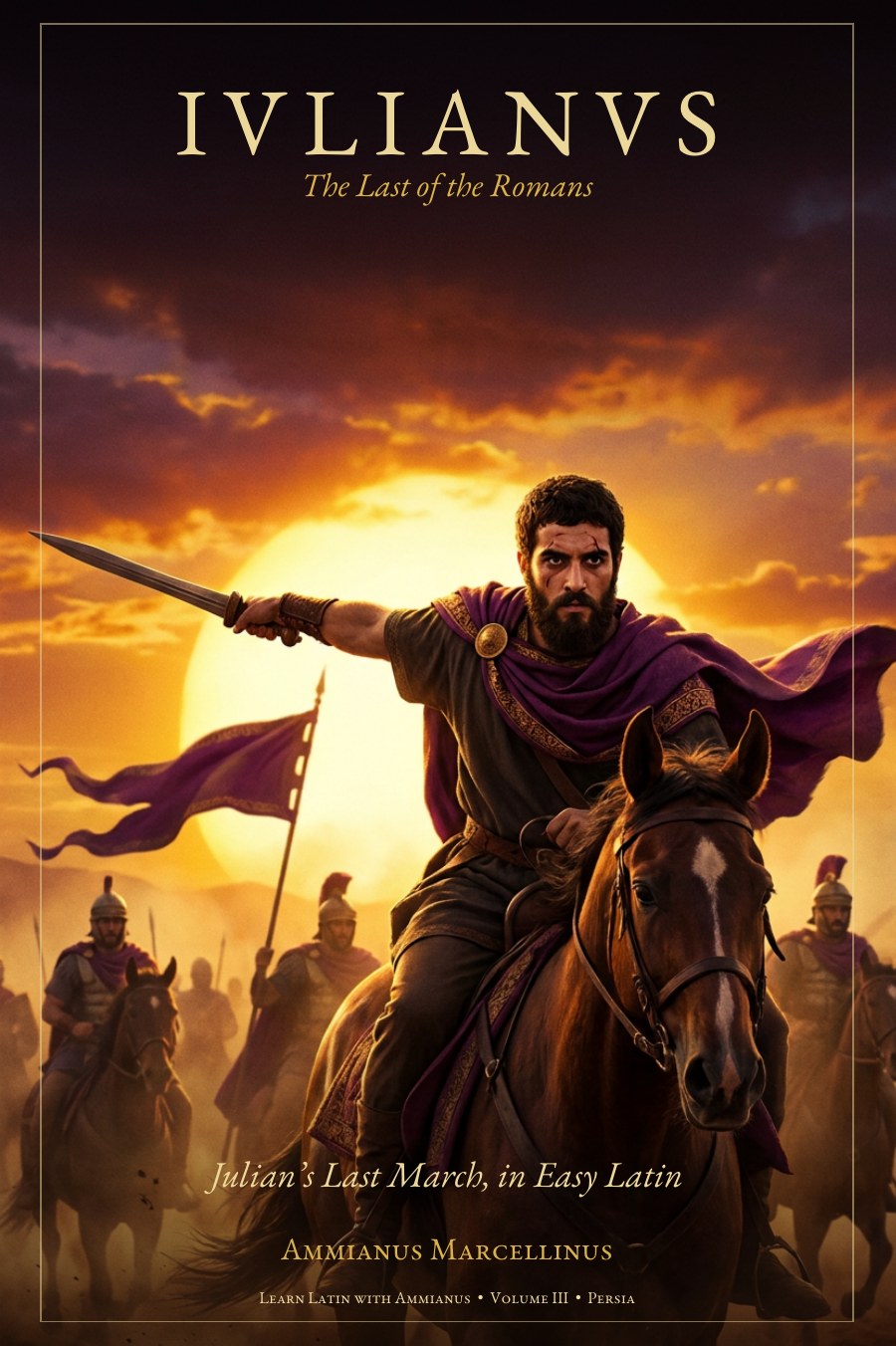
A thousand ships on the Euphrates. An emperor who reads Homer the night before battle. A spear no one ever claimed.
Antioch, March, A.D. 363. Julian rides out of the laughing city without looking back, toward the one thing no Roman emperor ever achieved: the conquest of Persia. The omens say no — the Sibyl herself says no, openly — and he goes. What follows is one of the great war stories of antiquity: the fleet like Xerxes' come again, cities taken through a hand-dug mine, the battle line arrayed by Homer before the walls of Ctesiphon — and then the turn: the fleet burned on a deserter's lie, the land itself set on fire, the iron-masked cataphracts, and one morning without a breastplate.
Ammianus Marcellinus rode in that column — this is the volume of vēnimus, WE came — and he was there after: at the lamplit tent where a dying philosopher-emperor calmly discussed the soul and asked for cold water; at the four days of hunger that sold five provinces; at the gates of Nisibis when a city that had never fallen was handed over by treaty. The book ends with the historian's own farewell to his reader — which, by then, you will read with no help at all. That was the plan from page one of Volume I.
"Haec ut mīles quondam et Graecus... prō vīrium explicāvī mēnsūrā: opus vēritātem professum."
— Ammianus, Rēs Gestae XXXI.16.9 · the historian's farewell — the trilogy's final panel, which you will read unassisted
Ipsa Verba: the Historian's Real Sentences
The signature of this reader: in every chapter, purple-framed IPSA VERBA panels present Ammianus' genuine, unaltered text — nothing simplified, nothing invented, every passage verified against the critical edition — followed by a friendly walkthrough in easy Latin. You read a real Roman historian from your very first week, and by the finale you are reading him nearly unassisted.
Latin Explained in Latin
As in every reader in this series, the margins carry the method: nearly nine hundred glosses explain each new word in easy Latin — a synonym, an opposite, a short definition — never an English crutch. The vocabulary builds on the core taught in Mīlle Verba and shared with our Dē Bellō Gallicō readers, so the series carries you from book to book without a dictionary. Along the way the book teaches you to read like a Latinist: dramatic irony, tricolon, correctiō, personification — each figure named and shown in Ammianus' own art.
Volume III of the Trilogy
PERSIA is the conclusion. It assumes GALLIA and IMPERIUM (or about three years of Latin): the excerpts run longest here, the glosses grow thin, and the last chapters you read nearly alone. Eighteen surviving books of Ammianus are waiting on the other side — this trilogy was always a staircase to them.