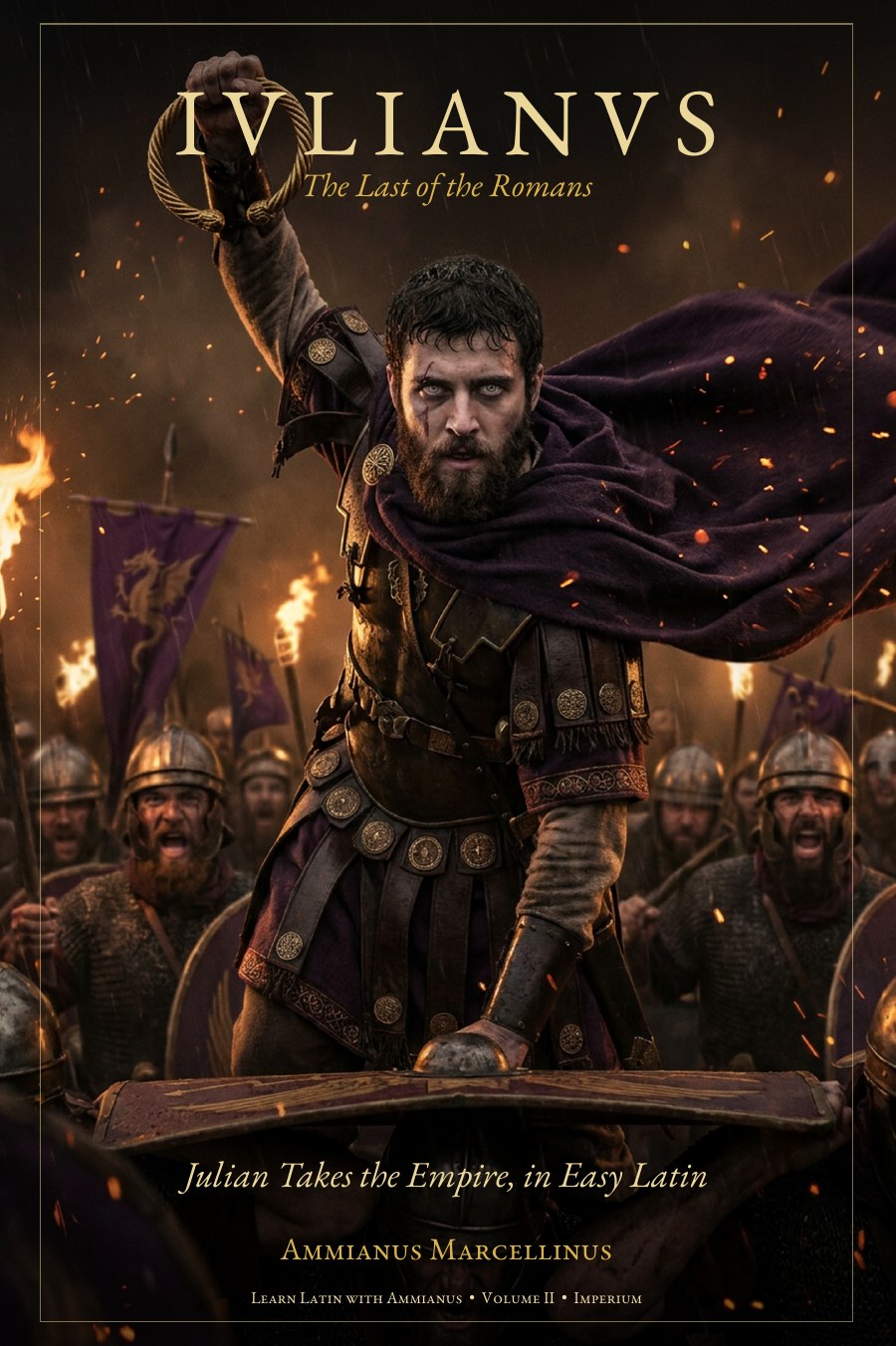
The last pagan emperor of Rome — told by a soldier who marched with him.
Gaul is burning, and the emperor — afraid of every shadow, above all the shadows of his own family — hands the ruined province to the only kinsman he has left: a twenty-three-year-old student who has never worn armor, mocked by the whole court for his philosopher's beard. His name is Julian. Within four years the laughingstock will smash seven kings in a single day at Strasbourg, cross the Rhine where no Roman has stood in a generation, and make an empire wonder what else the little Greek can do.
His story is told by Ammianus Marcellinus — the last great historian of Rome, a soldier who saw these wars with his own eyes — and retold here in graded, macronized Latin that explains itself as you read. Twenty-two chapters carry you from the whispering court of Constantius through the four-chapter battle of Strasbourg to the ice siege on the Meuse and the kings kneeling on the riverbank.
"Spūmāns dēnique cruōre barbaricō dēcolor alveus īnsuēta stupēbat augmenta."
— Ammianus, Rēs Gestae XVI.12.57 · seven words you will read unassisted, and never forget
Ipsa Verba: the Historian's Real Sentences
The signature of this reader: in every chapter, purple-framed IPSA VERBA panels present Ammianus' genuine, unaltered text — nothing simplified, nothing invented, every passage verified against the critical edition — followed by a friendly walkthrough in easy Latin. You read a real Roman historian from your very first week, and by the finale you are reading him nearly unassisted.
Latin Explained in Latin
As in every reader in this series, the margins carry the method: nearly nine hundred glosses explain each new word in easy Latin — a synonym, an opposite, a short definition — never an English crutch. The vocabulary builds on the core taught in Mīlle Verba and shared with our Dē Bellō Gallicō readers, so the series carries you from book to book without a dictionary. Along the way the book teaches you to read like a Latinist: dramatic irony, tricolon, correctiō, personification — each figure named and shown in Ammianus' own art.
Volume I of the Trilogy
GALLIA is the first of three volumes following Julian from student to Caesar to the throne of the world — and to the fate that waits under the Persian sun. The Latin ramps gently within this volume and across the trilogy: begin after Familia Romana or any first-year course, finish reading one of Rome's great prose stylists in the original.