A Lydian coin and a LaTeX command are instances of the same technology. Both impose bounded symbolic abstraction with feedback on a population of information-processing agents. Both produce reasoning that no one explicitly taught.
In 2025, a Chinese AI laboratory made a discovery that shook the technology industry. They gave a language model a single constraint — put your answer in a box — and a simple reward signal. From that minimal scaffold, the machine taught itself to reason.
Twenty-six centuries earlier, in three regions of the ancient world that had no contact with one another, something remarkably similar happened. Populations began handling a new technology — small stamped metal discs — in daily transactions. Within a generation, those same populations independently produced philosophy, rational inquiry, and abstract thought. No prior civilization had achieved this, despite millennia of cities, writing, and monumental architecture.
"A work of breathtaking intellectual ambition."
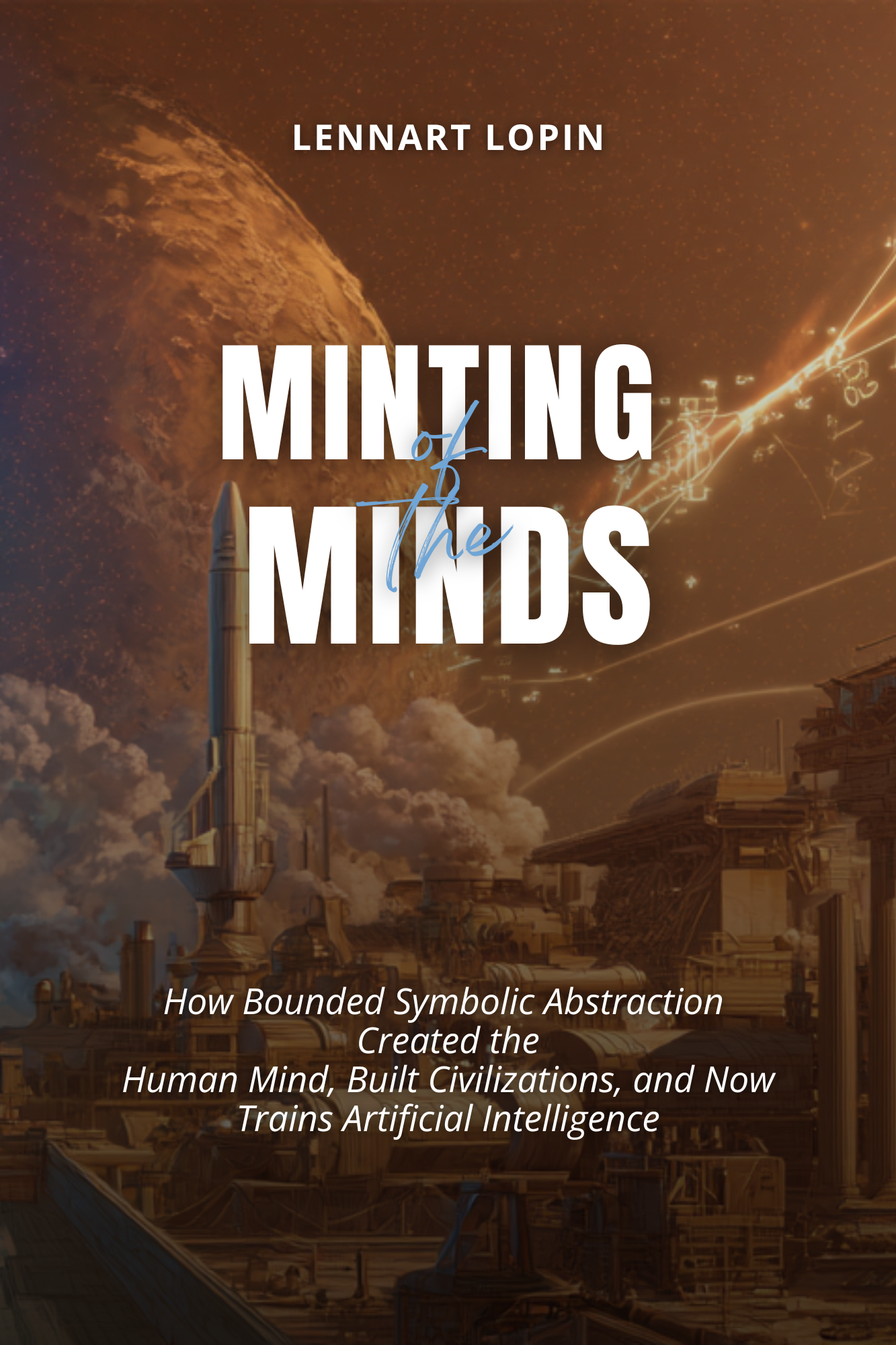
Minting Minds traces a single mechanism across thirty centuries of intellectual history: from the invention of coinage in Lydia, India, and China to the emergence of the Axial Age philosophers; from the financial revolution in early modern England to the birth of modern science; and from the structured training of artificial neural networks to the spontaneous emergence of machine reasoning.
Its implications reach from the ancient world to the future of education, cryptocurrency, artificial intelligence, and the settlement of Mars. This is your invitation to a joyride through the history of the mind.